
10 Reasons Why Fast and Decisive Hiring Is Critical When Engaging SAP S/4HANA Contractors
10 Reasons Why Fast and Decisive Hiring Is Critical When Engaging SAP S/4HANA Contractors
SAP S/4HANA transformations operate on momentum.
These programmes represent some of the largest and most strategically important technology investments organisations undertake. They run against fixed timelines, significant budgets and intense executive scrutiny.
When the right expertise is in place at the right time, programmes move forward with confidence. Design decisions progress, workshops remain productive and milestones are achieved.
But when critical roles remain unfilled, progress slows quickly.
Fit-to-standard workshops stall. Integration decisions are delayed. Internal SMEs become overstretched. Programme risk begins to increase.
One of the most underestimated success factors in S/4HANA programmes is therefore not technology or architecture — but the speed and decisiveness of contractor hiring.
In today’s competitive SAP talent market, recruitment delays are not simply administrative inconveniences. They are delivery risks.

Below are ten reasons why organisations running S/4HANA transformations must implement structured and decisive hiring processes when engaging SAP contractors.
1) The SAP S/4HANA Contractor Market Moves Quickly
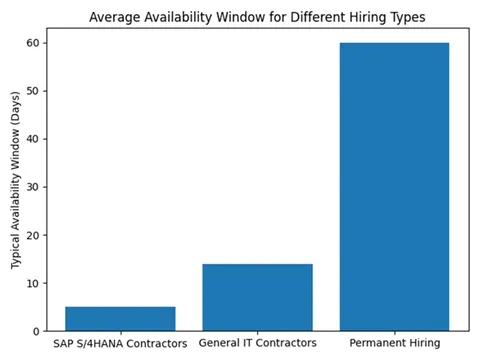
Contractor availability operates very differently from permanent hiring.
Highly experienced SAP S/4HANA specialists — particularly those with full lifecycle implementation experience — remain in strong demand across Europe. Contractors often secure new engagements within days of becoming available.
Lengthy approval processes, extended interview rounds or delayed feedback frequently result in organisations losing preferred candidates to competitors that move faster.
In this environment, speed signals organisational clarity and confidence. Indecision signals risk.
At Eursap, we regularly see SAP contractors managing multiple concurrent opportunities where the differentiating factor is not the day rate — but how quickly an organisation can make a decision.
Organisations that prepare hiring frameworks and approval authority in advance are significantly better positioned to secure top talent.
2) Programme Gaps Compound Rapidly
In large transformation programmes, capability gaps rarely remain isolated.
If a Finance Lead, Data Migration Specialist or Enterprise Architect role remains vacant, the impact quickly spreads across the programme.
Design workshops may need to be postponed. Integration decisions remain unresolved. Downstream teams wait for architectural guidance before progressing their own workstreams.
Internal SMEs are often asked to temporarily bridge these gaps, balancing project responsibilities with operational roles. Over time this creates fatigue, slows decision-making and increases delivery risk.
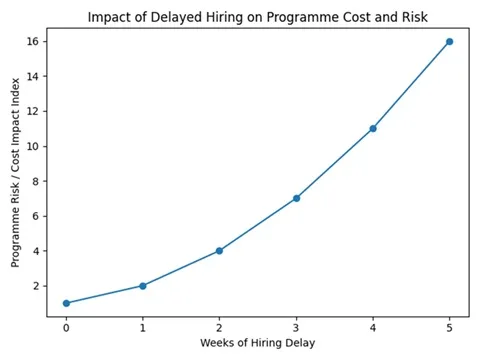
What begins as a short recruitment delay can rapidly cascade into compressed testing windows, additional change requests and reactive decision-making later in the programme lifecycle.
The cost of delay is rarely linear — it accelerates.
3) High-Calibre SAP Contractors Evaluate You Too
Experienced S/4HANA contractors assess organisations just as carefully as organisations assess them.

Contractors with strong delivery track records have often worked on multiple large ERP transformations. As a result, they quickly recognise indicators of programme health — including governance maturity, decision-making clarity and organisational alignment.
Slow hiring processes, unclear communication or inconsistent interview feedback can raise concerns about programme stability.
By contrast, a streamlined recruitment process demonstrates strong leadership and organisational confidence — factors that help attract the best available talent.
4) Recruitment Delays Increase Commercial Exposure
When critical roles remain unfilled, organisations often compensate by relying more heavily on system integrators or consultancy partners.
While these partners play an important role in transformation delivery, excessive reliance can increase programme costs and reduce independent client-side oversight.
Alternatively, internal SMEs may become overextended while attempting to support programme demands alongside operational responsibilities.
Both scenarios increase commercial and operational exposure.
Securing the right SAP contractor quickly helps stabilise programme delivery, strengthen internal governance and protect budget control.
5) Transformation Timelines Do Not Pause for Recruitment
S/4HANA programmes move through clearly defined phases: discovery, design, build, testing, cutover and stabilisation.
These phases are highly interdependent.
If critical expertise is not secured at the start of a phase, recovery becomes increasingly difficult. Design decisions may be delayed, testing cycles may be compressed and cutover risk increases.
Successful organisations align recruitment planning with programme phase milestones — rather than traditional HR timelines.
In transformation environments, resource planning must move at programme speed.

6) Delayed Decision-Making Reduces Market Engagement
In competitive contractor markets, responsiveness directly influences candidate engagement.
Specialist SAP recruitment partners invest significant effort identifying, qualifying and engaging experienced S/4HANA contractors. However, when hiring processes lack urgency or clarity, it becomes increasingly difficult to maintain candidate interest.
Highly sought-after contractors will naturally prioritise opportunities where interview processes are structured, communication is clear and decisions are made efficiently.
Similarly, recruitment partners will allocate greater attention to programmes demonstrating momentum and commitment.
A decisive hiring process strengthens an organisation’s credibility within the SAP talent market.
7) Momentum Builds Programme Confidence
Successful S/4HANA transformations build visible progress.
When specialist expertise is secured quickly, decision cycles accelerate and stakeholder confidence increases. Programme leadership gains clarity. Delivery teams maintain focus.
Conversely, prolonged recruitment processes create uncertainty. Stakeholders may question governance alignment, budget approval or programme commitment.
Momentum is not purely operational — it is psychological.
Maintaining forward progress is essential to sustaining organisational confidence throughout a transformation journey.

8) The Cost of Delay Is Often Greater Than the Cost of the Hire
Some organisations extend hiring cycles in an attempt to reduce perceived risk.
While due diligence is important, overly complex interview processes rarely provide proportionate additional assurance.
Meanwhile, every week a critical role remains vacant introduces cumulative delivery risk.
Structured interviews aligned with clear capability criteria are far more effective than lengthy exploratory conversations.
Specialist SAP recruitment partners can significantly streamline this process by pre-qualifying technical expertise, programme experience and cultural fit before candidates are presented.
9) Slow Processes Often Mean Losing the Best Talent
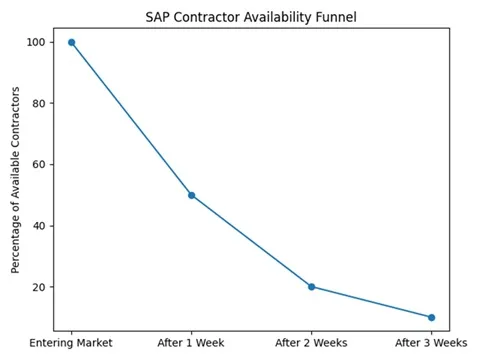
In the S/4HANA contractor market, the most experienced professionals rarely remain available for long.
Contractors with strong delivery experience — particularly those who have successfully led complex design phases, integrations or programme recoveries — are frequently approached by multiple organisations simultaneously.
When hiring decisions are delayed by extended scheduling timelines or prolonged internal discussions, the strongest candidates often accept alternative offers.
Organisations may then find themselves choosing from a smaller and less competitive talent pool.
A decisive recruitment process ensures access to the best available expertise at the moment it becomes available.
10) Decisiveness Reflects Leadership Strength
Ultimately, hiring velocity reflects governance clarity.
Clear approval authority, defined interview stages and aligned budget sign-off enable rapid engagement with suitable candidates.
Fragmented decision-making structures, by contrast, slow programmes unnecessarily.
In large S/4HANA transformations, decisive hiring sends a powerful signal — both internally and externally — that leadership is aligned and confident in the programme’s direction.
How to Create a Faster and More Effective Hiring Process
Organisations looking to strengthen their recruitment discipline and improve time-to-hire should consider the following practical steps:
- Define clear job specifications early - Ensure all stakeholders align on responsibilities, deliverables and required expertise before initiating the search.
- Maintain consistency in search criteria - Changing role scope mid-process often delays hiring and risks losing engaged candidates.
- Confirm budget and approval authority upfront - Removing approval uncertainty allows hiring managers to act quickly when strong candidates are identified.
- Address compliance requirements early - For example, confirming IR35 status in the UK at the outset prevents delays at offer stage.
- Align interview criteria to programme phase needs - Assess expertise relevant to the current transformation stage rather than generic SAP experience alone.
- Limit interviews to essential decision-makers - Additional interview layers rarely provide proportionate value.
- Interview candidates in parallel rather than sequentially - Sequential interviews significantly increase the risk of losing strong candidates.
- Provide feedback within 24–48 hours - Prompt feedback helps maintain candidate engagement and protects employer reputation.
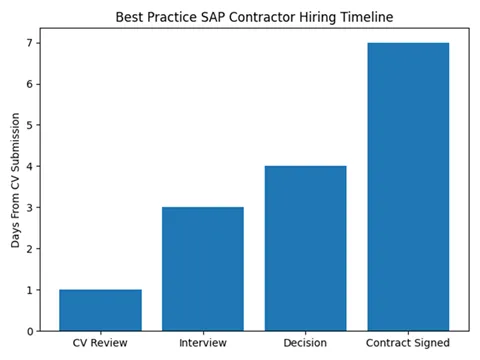
- Aim for a time-to-hire of one week or less - For critical SAP contractor roles, organisations should ideally move from CV presentation to contract signature within this timeframe.
With the support of a specialist SAP recruitment partner, organisations can achieve both speed and rigorous quality control.

Final Thoughts
SAP S/4HANA transformations are demanding programmes that already involve significant technical, organisational and commercial complexity.
Avoidable recruitment delays only increase this pressure.
In today’s competitive SAP contractor market, organisations that move decisively gain a clear advantage. They secure the best expertise, maintain programme momentum and reduce delivery risk.
Those that move slowly often find themselves restarting recruitment processes, paying higher rates or relying more heavily on external consultancies.
At Eursap, we specialise exclusively in SAP recruitment across Europe.
Our consultants understand the structure, timelines and resource challenges of S/4HANA transformations. We work closely with programme leaders and hiring managers to identify and secure experienced SAP contractors — often within days.
Beyond sourcing candidates, we also help organisations:
- Benchmark SAP contractor availability across Europe
- Understand competitive market rates
- Design efficient interview processes
- Align recruitment strategy with transformation timelines
If your organisation is currently planning or executing an SAP S/4HANA transformation, a short discussion with one of our SAP recruitment specialists can provide valuable market insight.
Book a meeting with an Eursap SAP Recruitment Manager today to review your upcoming hiring requirements and ensure your recruitment process supports — rather than delays — your transformation programme.
A short conversation today could prevent costly delays tomorrow.
If you found this Blog article useful, you may also be interested to read:
Staff Churn During SAP S/4HANA Transformations: Why It Happens & How to Prevent It
Top 10 Resources Needed on the Business Side of an SAP S/4HANA Transformation
More Blogs


