
Dr. Klutz, or How I Came to Love the ABAP Debugger
Dr. Klutz, or How I Came to Love the ABAP Debugger.
Part 1. Dr. Klutz
There are two types of SAP consultants. The first is a graduate of some technical institute who majored in data science, engineering, or possibly nuclear physics. These guys can rip apart (and reassemble) wires with their teeth because they rebuilt circuit boards when they were in pre-nursery school. These are “Technical” resources.
The second type are those who were exposed to SAP in a business context. After gaining proficiency in complete process flows, they would typically backfill into skilled activities like table dives via queries and, if they are really clever, dabble in pseudo code. Say hello to “Functional” consultants.
So, which one are you?
I self-identify in the second group.
In my 20+ years of experience, there was often a project team member whom the others would call, “The Mad Debugger.” Sometimes, to play along, this guy would cross his eyes and appear to be crazy while pounding the keyboard. But he was not at all nuts.
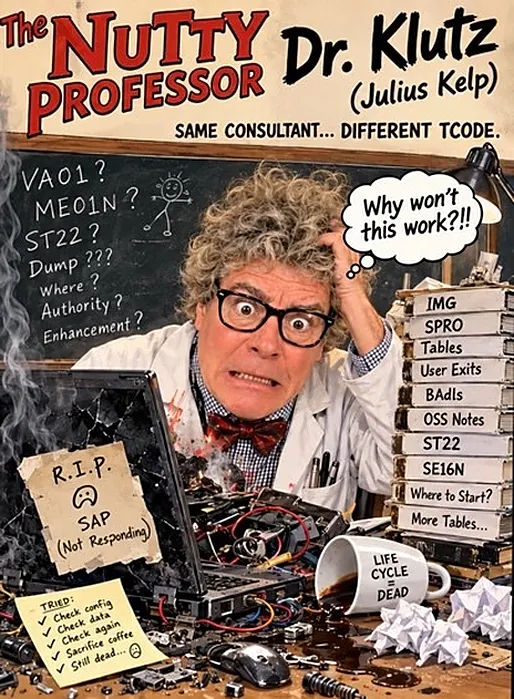
He possessed a skill that I, as a member of the second group, secretly admired.
You see, he could harness a wild-looking SAP program called the ABAP Debugger, which could reveal exactly what ECC or S/4HANA was doing.
As Freud would say, I had contracted “debugger envy.” In our world of Unwashed Cores, SAP frequently does weird things. The Debugger can reveal root causes obscured under layers of code, function modules, programs, routines, user exits, enhancements, commented ABAP, incomprehensible SAP marketing, spilled coffee on the keyboard, spiteful German expressions, or even just plain standard functionality.
I had asked over the years if those with this talent could show me the ropes. Sure, they would say, “just type ‘/h’ in the transaction code field.”
Fat chance. For me, it just opened an incomprehensible screen with multiple panes.
Enter AI. Now with the world’s knowledge at your fingertips – “ask me any question, anything,” could my buddy ChatGPT provide the necessary coaching and guidance where others would not?
After all, ChatGPT thinks I’m a genius! It persuaded me that I could change the battery on my five-year-old Dell laptop. Like SpongeBob, I gleefully did what I was told and succeeded only in bricking my computer.
But I digress. ChatGPT could guide me in correctly interpreting Debugger screens, right? So, I resolved to try it.
Specifically, I was creating a Sales Order in S/4HANA using Customer 140100 with material 553100 under Sales Area US12/20/00. I had used this material successfully many times with a different Customer in the same Sales Area. However, for this particular combination, S/4HANA generated, without explanation, error VP210 to the effect that my customer was not defined for Sales Area US12/20/01.
Huh? How and why did the division code change from 00 to 01? I specifically defined the Sales Area US12/20/00 up front while writing the order.
Where does S/4HANA get off changing my Sales Area?
Naturally, I suspected some customization. There were heaps of it in my environment, I knew. And everyone was too busy to mansplain it to me. Classic.
So, I decided, if there was ever a time to crack open the dark arts of the “technical” folks – this was it.
True to form, ChatGPT led me down more than a few dead ends. But as opposed to soldering chips to a motherboard (where I clearly had no business doing so), I had enough experience with SAP to run my BS meter over the ChatGPT prompts.
Part 2. Or, How I Came to Love the Debugger
As the error was linked to a change in customer/material usage, my first inclination was to check inclusion/exclusion lists. So, I dutifully inspected VB03 to see if my customer or material numbers were mentioned. They weren’t. I also checked VB13 for classic Material Determination. Nothing there either.
Like most consultants on a new project, I suspected custom code. However, just because you don’t recognise the error doesn’t mean that it’s not standard functionality. A wonderful way to end up with egg on your face on a new project!
Either way, the Debugger could sort this out. Well, I reasoned, I always wanted to learn how to use it. If not now, when? I rolled up my sleeves.
So, here follows my summarised account to determine the root cause in sixth-grade English.
A) Uncork the Debugger
To initiate a debugging session, one starts by navigating to the exact screen and inputs/keystrokes JUST BEFORE the error. Carefully, I repeated all keystrokes in VA01 to input Sales Document Type, Sales Area, Customer, and Customer PO. All inputs before that Division error. Then, once the stage was set, I entered the cryptic ‘/h’ command in the OK field. Debugging activated.
I then entered the material and quantity into VA01 and pressed Enter, which launched the ABAP Debugger in all its multi-paned glory.
The Debugger does not simply display one comprehensible program listing. Rather, it shows you a live view of the execution of layer after layer of code. ChatGPT turned my attention to the ABAP and Screen Stack on the right to see where SAP had traveled. This direction was exactly what I had been missing.
B) Grab the Rope
As to the Division code switcheroo, ChatGPT pointed me towards routine VBAP_SPART_FUELLEN. Instead of trying to understand exactly what this routine does, our analysis focused on a few variables in OBJECT-FIELD notation that seemed to be directly associated with the moment when the unexpected Division value appeared:
VBAK-SPART
VBAP-SPART
MAAPV-SPART
MAAPV-MATNR
C) Learn to Use a Watchpoint
You can run your standard (or customized) program via the Debugger and ask it to stop execution when X – which you define -- happens. To do this, you use watchpoints.
Here, ChatGPT had me set a watchpoint on VBAP-SPART to stop whenever the S/O line-item Division value changed. This was probably my first genuinely useful debugger technique. Instead of manually stepping through acres of ABAP, I effectively instructed the Debugger to ring my doorbell whenever somebody touched the Division.
D) Spot the Clue That Changed the Investigation
While following the execution path and examining the variables, we discovered that something else was going on in addition to the Division 01 swap.
The material SAP was processing had mysteriously changed from 553100 to 553200.
That was the aha moment. Suddenly this wasn't primarily a division-determination issue. Something inside order processing was introducing another material.
E) Deciphering the Clues and Determining Exactly What Was Going On
ChatGPT guided me through the Call Stack – the sequence of programs, routines, functions, or methods SAP followed to arrive at the code currently being executed – particularly CROSS_SELL_PRUEFEN and CROSS_SELL_SELECTION. These belonged to SAP's standard cross-selling functionality. My experience there was cursory at best.
Then came the really important empirical discovery: while I had entered 553100, the debugger showed MAAPV-MATNR = 553200, with MAAPV-SPART = 01.
All of this gave me, the functional guy, a functional avenue to investigate. I subsequently found the ZCS1 condition record in VB43 connecting the material I had entered to the mysterious material appearing in the debugger. In other words, for this customer, if the user inputs 553100, SAP says: “also sell ‘em 553200.”
There it was. The debugger had exposed the behavior; ordinary SAP configuration/master-data investigation revealed its source.
F) The Solution
New Material 553200 carries Division 01. Customer 140100 is maintained for US12/20/00, but not US12/20/01. Once the cross-selling logic caused SAP to evaluate 553200, SAP attempted to validate the customer against Division 01. The customer was not extended to that Sales Area, so SAP generated VP210.
For testing purposes, the immediate solution was to extend the customer to the additional Sales Area. In production, of course, one would first confirm that both the cross-selling relationship and the customer's extension into Division 01 were intended.
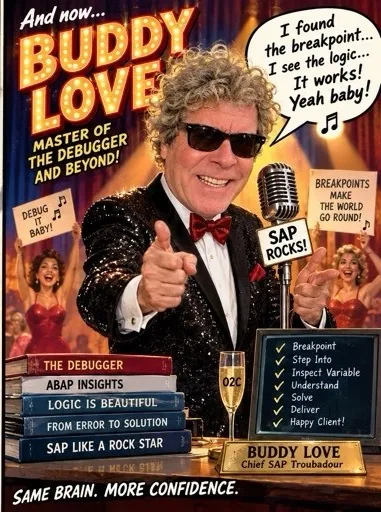
The major lesson from my Debugger learning exercise is that ChatGPT is not going to solve all your problems while you sleep late in bed or stay out late in Irish saloons. Rather, it’s more like the friendly dance-club bouncer who waves you through the crowd and past the velvet ropes. You still have to know where you are going.
Put another way, ChatGPT can lower the barrier between technical and functional expertise. But you've got to bring enough knowledge to interpret the clues.
That means challenging ChatGPT. Constantly. To use the ABAP Debugger effectively to solve a functional SAP problem, you still need to know SAP.
So, give yourself credit for what you already know. Don't be intimidated when ChatGPT starts spouting structural terms you've never heard before. Call stacks, call shtacks. Like almost everything else in SAP, there are things inside other things. Set theory from high school, baby.
The ABAP Debugger is ultimately just another tool for searching for clues and chasing leads. Follow them. Bring the dogs and torches if necessary. And keep looking until you find the hideous VB43 thing hiding in the barn under overcast skies.
More Blogs


