
Agentic AI in SAP: The Death of the Functional Consultant? & The Economic Reality
Agentic AI in SAP: The Death of the Functional Consultant? & The Economic Reality of LLMs.
The agentic AI conversation in SAP has mostly been about capability: what Joule Agents can now do across finance, procurement, supply chain and HR. That's the visible part. The part getting far less airtime is what happens to the people who used to do that work, and what happens to the economics once every one of those agents is running a live token bill, every hour, at enterprise scale.
Both matter more than another product announcement.
From module expert to process owner
The traditional SAP functional consultant role was built around configuration. Know FI/CO, know how to set up the ledger, know the transaction codes, be the person the business calls when something in that module breaks. That was a deep, valuable, defensible skillset for twenty years.
Agentic AI doesn't remove that knowledge requirement; it relocates it. When a Joule Agent is executing the process end-to-end, configuring the module well stops being the differentiator, because the agent configures it. What's left, and what becomes far more valuable, is understanding how the business process actually runs across modules, where it touches other processes, where it can go wrong, and being able to catch it when an agent gets something wrong. That's a business process consultant, not a module consultant. The centre of gravity moves from "I know how SAP does this" to "I know how the business needs this to work, and I can tell when the system is doing it badly."
I'm already seeing this in client briefs. Fewer requests for "an FI/CO consultant" in isolation, more for someone who understands FI/CO and can sit alongside how that process is being automated.
Where it's heading: the architect running a team of agents
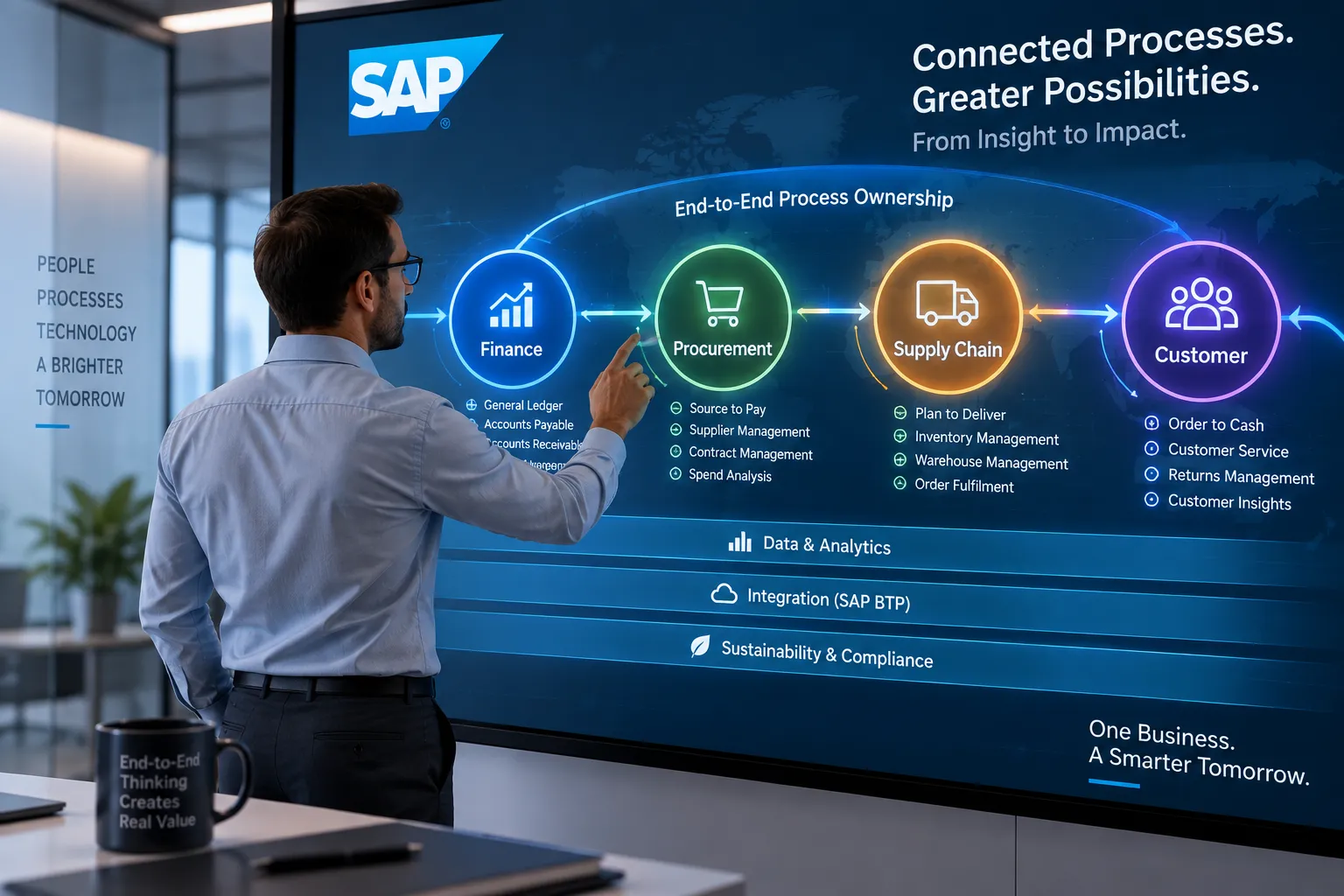
Take that a step further and the shape of the role that's coming into view is closer to a conductor than a configurator. Instead of five functional consultants each owning a module, you have an architect who understands how finance, procurement, supply chain and HR connect as one system, orchestrating a set of agents that each act in the role a functional consultant used to occupy. The architect isn't doing the configuration or running the transactions. They're setting the process design, defining the guardrails, reviewing what the agents produce, and intervening where judgement is required.
That's not a five year projection; the building blocks are already live: SAP's Autonomous Suite running finance, spend, supply chain, HCM and customer experience as one connected system, agent-to-agent orchestration through Joule Studio, governance and audit trails built in rather than bolted on. The organisational structure hasn't fully caught up with what the technology already allows, but it will, because the economics of one senior architect overseeing eight agents versus eight separate functional hires are not subtle.

The cost curve nobody's pricing in yet
Here's the part that gets skipped. Every one of those agents, every review cycle, every multi-step orchestration across modules, runs on inference, and inference isn't free. It's priced per token, and that price is not static.
The current trajectory of AI data centre build-out, the scale of capital going into compute, power and cooling, points towards rising infrastructure cost being passed through as rising token cost, not falling. That's the opposite of the assumption baked into most transformation business cases right now, which tend to treat AI inference as a rounding error that only gets cheaper. At enterprise scale, with agents running continuously across every process in the Autonomous Suite, token cost stops being a rounding error and starts being a line item finance actually has to model.
Which is where the second shift comes in. Chinese LLMs are already being offered at somewhere between a tenth and a hundredth of the cost of the leading American models for comparable inference workloads. For a business running agentic workloads at real scale, that isn't a marginal saving, it's the difference between agentic AI being viable at the process level SAP is now pitching, or being viable only for a handful of high-value use cases. Expect procurement conversations in the next 18 to 24 months to start asking a question that sounds unusual today: which model is actually orchestrating our agents, and what does that cost per thousand transactions, not just which platform sits on top.
What it means for hiring
Put the two threads together and the shape of the SAP workforce over the next few years looks like this. Fewer people needed to configure and run individual modules, because agents increasingly do that. More value placed on people who understand business process end-to-end and can direct and audit a set of agents doing what a team of consultants used to do. And a genuinely new layer of demand around AI cost governance, people who understand token economics, model selection and inference cost as a live operational lever, not a one-off IT decision.
For clients, the talent you need to stand up an agent-orchestrated function isn't the talent you needed for a module rollout. For candidates, module knowledge got you the last fifteen years, process fluency and the ability to sit above a team of agents gets you the next fifteen.
More Blogs


