
SAP BTP for Business Innovation: Practical Use Cases and Implementation
SAP BTP for Business Innovation: Practical Use Cases and Implementation Strategies.
Businesses are always being pushed to innovate, improve efficiency and provide better customer experiences. Yet organisations running SAP systems face a familiar challenge: how can they introduce new capabilities without disrupting core processes or making their enterprise resource planning (ERP) landscape more complex?
SAP Business Technology Platform (BTP) helps address this challenge through application development, integration, automation, data management and artificial intelligence (AI). It enables organisations to extend SAP applications and connect existing systems while supporting a cleaner, more adaptable core.
SAP continues to use the SAP BTP name for these platform capabilities, which support SAP's broader Business AI strategy. This highlights the increasing need for connecting enterprise applications, business data, workflows and AI. More information on the platform’s capabilities can be found on SAP’s website.
This guide covers practical SAP BTP use cases, implementation strategies, common issues and methods on how to measure business value. It also shows how a clean core approach can enable innovation without adding unnecessary complexity to the ERP landscape.
What Is SAP BTP and Why Does It Matter?
SAP BTP helps organisations integrate, extend and innovate across SAP and non-SAP environments. Its capabilities support application development, integration, automation, data and analytics, and AI-enabled business processes.
It complements SAP S/4HANA, which supports core ERP processes. Extensions, integrations and workflows related to those processes can be supported by suitable BTP services.
For example, a company using S/4HANA might need a custom approval application, an integration with a logistics provider or automated document processing. Rather than unnecessarily changing the ERP system, the company can build those capabilities by leveraging appropriate platform services.
This supports the SAP clean core approach, which is an approach to keep the ERP core as standard as practical and to use supported extension methods to provide additional functionality. A cleaner core can make upgrades and maintenance easier but the benefits depend on the architecture, extension choices and governance of each implementation.
Professionals looking to understand SAP BTP concepts in greater depth can explore the C_ADBTP Preparation Guide for relevant certification topics and exam preparation guidance.
Service availability, licensing and commercial terms can vary. Organisations should check current SAP documentation and their contracts before selecting services.
Five Practical SAP BTP Use Cases for Innovation
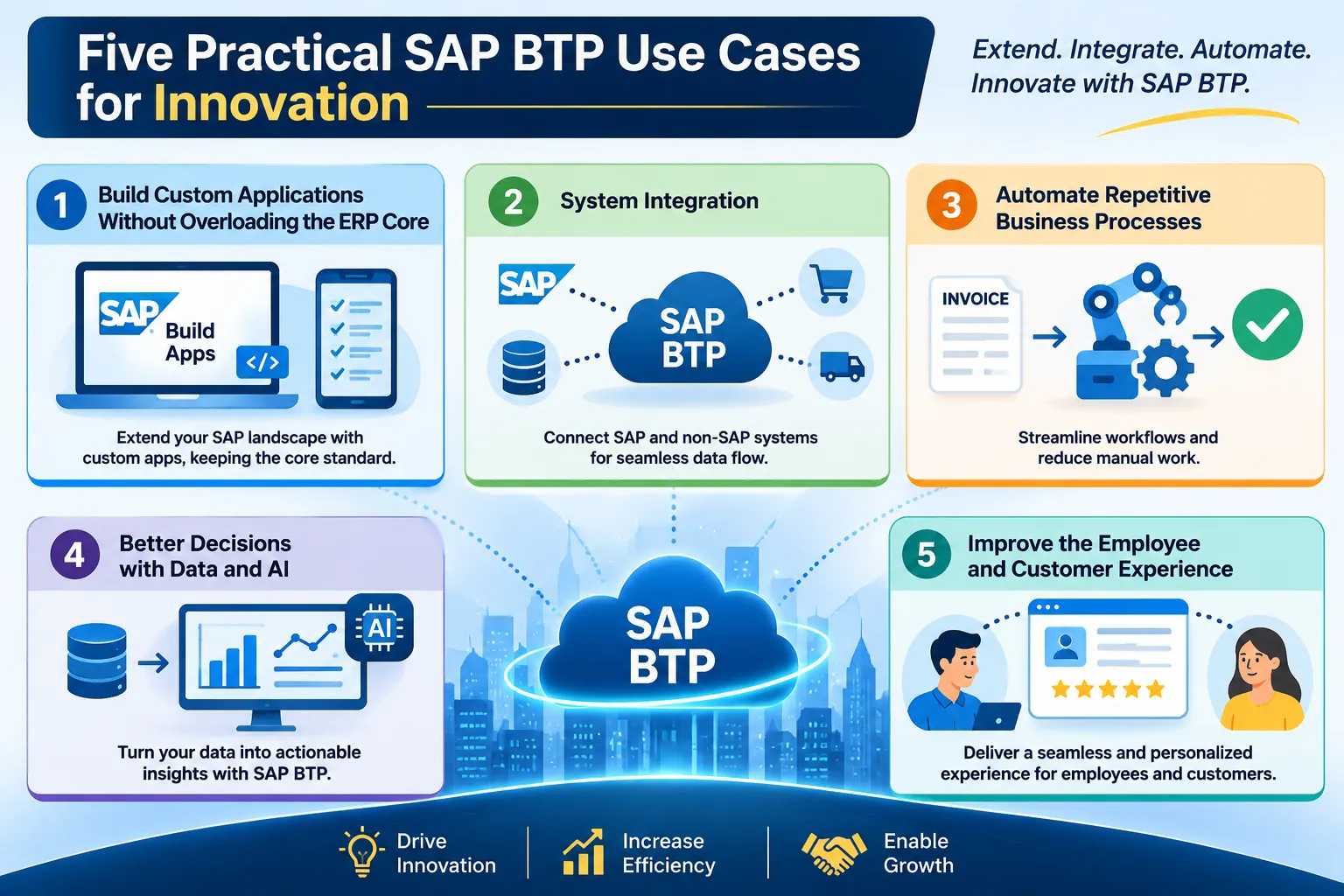
1. Build Custom Applications Without Overloading the ERP Core
- The problem: Standard ERP applications won’t cover every need. Teams end up patching the gaps with spreadsheets, manual entry or disconnected tools.
- How SAP BTP helps: SAP Build and the other development tools help organisations build custom apps. This approach keeps the ERP core as close to standard as possible.
- Customer example: Harrods used SAP BTP to extend its existing SAP landscape. It includes mobile solutions, user experience improvements and automation.
- Illustrative scenario: A manufacturer builds a mobile inspection app. Technicians log equipment checks and access the SAP data they need in real time.
- Expected benefit: Less duplicate data entry, better productivity and extensions that are easier to maintain.
2. System Integration
- The problem: When SAP cloud and third-party applications don’t communicate then data becomes inconsistent, teams reconcile by hand and processes slow down.
- How SAP BTP helps: SAP Integration Suite connects SAP and non-SAP systems through APIs and prebuilt integration content.
- Customer example: According to Harrods’ SAP customer story, process times fell by 30% and total cost of ownership dropped by 40% across its integration landscape.
- Illustrative scenario: A retailer links its ERP, e-commerce platform and logistics provider. Thus orders, inventory and delivery updates are synchronised.
- Expected benefit: More consistent data, less manual reconciliation and more visibility into integration problems.
- Tip: Professionals interested in exploring related certification resources can browse SAP BTP System certifications to learn more about relevant learning and exam preparation options.
3. Automate Repetitive Business Processes
- The problem: Tasks like invoice handling, purchase approvals and employee onboarding consume time and invite mistakes.
- How SAP BTP helps: SAP Build Process Automation combines suitable workflows, robotic process automation and business rules to streamline routine work.
- Customer example: SAP’s Harrods case study covers its integration modernisation and its use of SAP BTP capabilities, including better process visibility.
- Illustrative scenario: A company automates invoice routing, verifies the required details and sends exceptions to staff for review.
- Expected benefit: Faster processing, fewer manual steps and more time for people to deal with exceptions.
4. Better decisions with data and AI
- The problem: Information is scattered across systems and in documents. So finding it, sorting it and acting on it eats up a lot of time.
- How SAP BTP helps: Depending on which services you pick, SAP BTP lets you build AI-powered apps and workflows for handling documents, analysing data and pulling out insights.
- Customer example: The City of Hamburg used SAP BTP with AI to automatically classify and evaluate 6 million documents. They were submitted through platform to apply for cultural energy fund.
- Illustrative scenario: Procurement team creates an AI facilitated workflow. The workflow reads incoming documents and then routes them to the exact department.
- Expected benefit: documents processed faster, less manual sorting by people, less effort to review exceptions.
5. Improve the employee and customer experience
- The problem: Even simple, routine tasks can mean switching between several unconnected applications, whether you’re an employee or a customer.
- How SAP BTP helps: Its development and integration tools can combine data and workflows in one place, so the experience feels more joined up.
- Customer example: Harrods’ SAP customer story explains how SAP technology supports its digital customer experience and its customer-data work.
- Illustrative scenario: A service team can see a customer’s details, service history and next steps all on one screen, so no one needs to go between systems.
- Expected benefit: Information is easier to find, workflows flow smoothly and tasks might get done faster.
How to be successful with an SAP BTP implementation
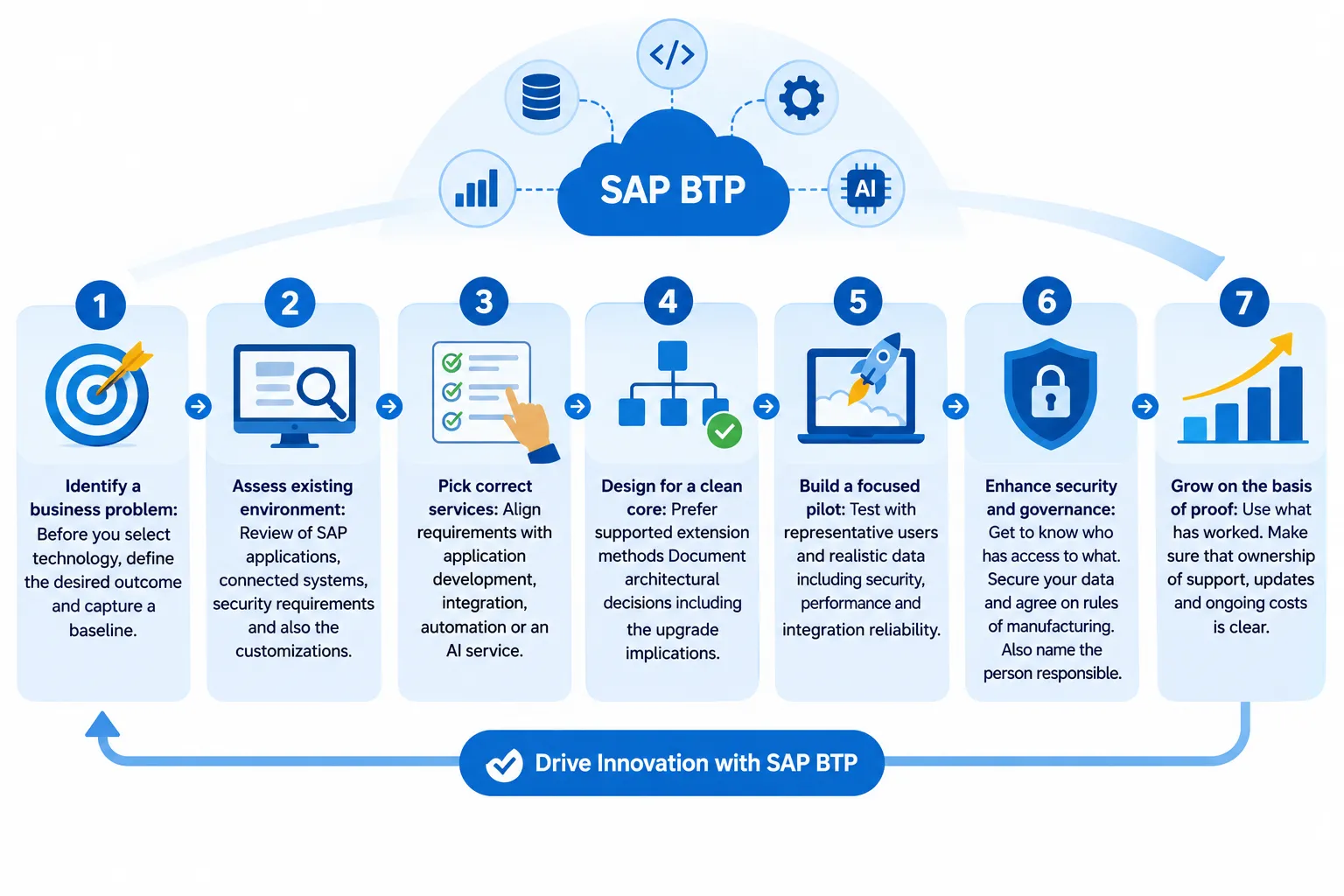
By performing this in phases you can manage risk and show value before you scale the investment. The following steps are a practical starting point for an SAP BTP implementation.
- Identify a business problem: Before you select technology, define the desired outcome and capture a baseline.
- Assess the existing environment: Review SAP applications, connected systems, security requirements and the customisations.
- Pick the correct services: Align requirements with application development, integration, automation or an AI service.
- Design for a clean core: Prefer supported extension methods. Document architectural decisions including the upgrade implications.
- Build a focused pilot: Test with representative users and realistic data including security, performance and integration reliability.
- Enhance security and governance: Get to know who has access to what. Secure your data and agree on rules of manufacturing. Also, name the person responsible.
- Grow on the basis of proof: Use what has worked. Make sure that ownership of support, updates and ongoing costs is clear.
Common Challenges and How to Address Them
SAP BTP for innovation has to be planned with care, because the platform doesn’t take care of the technical challenges itself.
- Unclear objectives: Define measurable outcomes and assign a business owner before development.
- Integration complexity: Document dependencies and monitor the error recovery and maintainability plan.
- Too personalised: Try to use what you already have. Keep an eye on every app and every change.
- Maintenance: Each solution needs to have an owner. Get ready for updates. Also, don’t forget to budget for support.
If you deal with these early, your solutions will be safer and easier to manage. They will also fit what your business needs. It also supports SAP clean core principles by avoiding unnecessary changes to standard SAP systems and choosing suitable ways to add new features.
Measuring the Business Value of SAP BTP
Track success with KPIs that tie back to the original business problem.
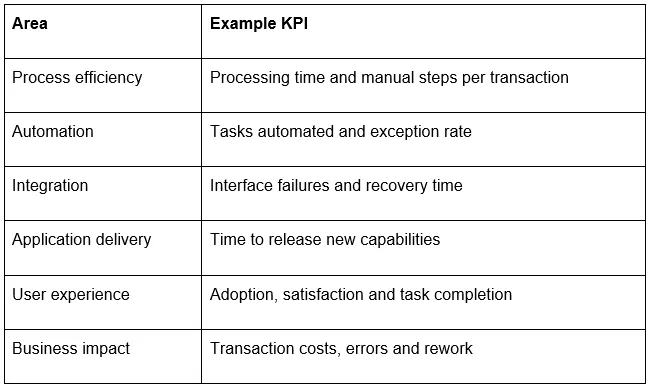
Set a benchmark before you start. Then judge the benefits using real operational data. Add up all the expenses when calculating the financial impact. That includes development, licensing, support and running expenses.
SAP publishes business value research, but it is sponsored by the vendor. Treat it as background, not a commitment. Your results will depend on your scope, your costs and how much people use the solution.
Pick KPIs that suit each project. An integration project might track failed transactions. An automation project might track processing time and how many manual interventions were cut.
The Future of SAP BTP for Innovation
As organisations adopt cloud systems, AI and more connected business processes, BTP capabilities are likely to remain important to enterprise innovation. SAP's platform strategy emphasizes connecting applications, data and workflows while supporting the development and governance of AI-enabled applications.
However, adopting new capabilities should not become the objective in itself. It’s all about solving visible business problems, protecting sensitive data and being responsible for the results, and that’s how you get sustainable outcomes.
As automation and AI become more capable, organisations need reliable data, clear permissions, monitoring, auditability and appropriate human oversight. The same approval rights and data-protection obligations apply whether a task is completed by a person or an AI-enabled process. Product features and availability are subject to change. Check current documentation and licensing prior to finalising your design.
Final Thoughts
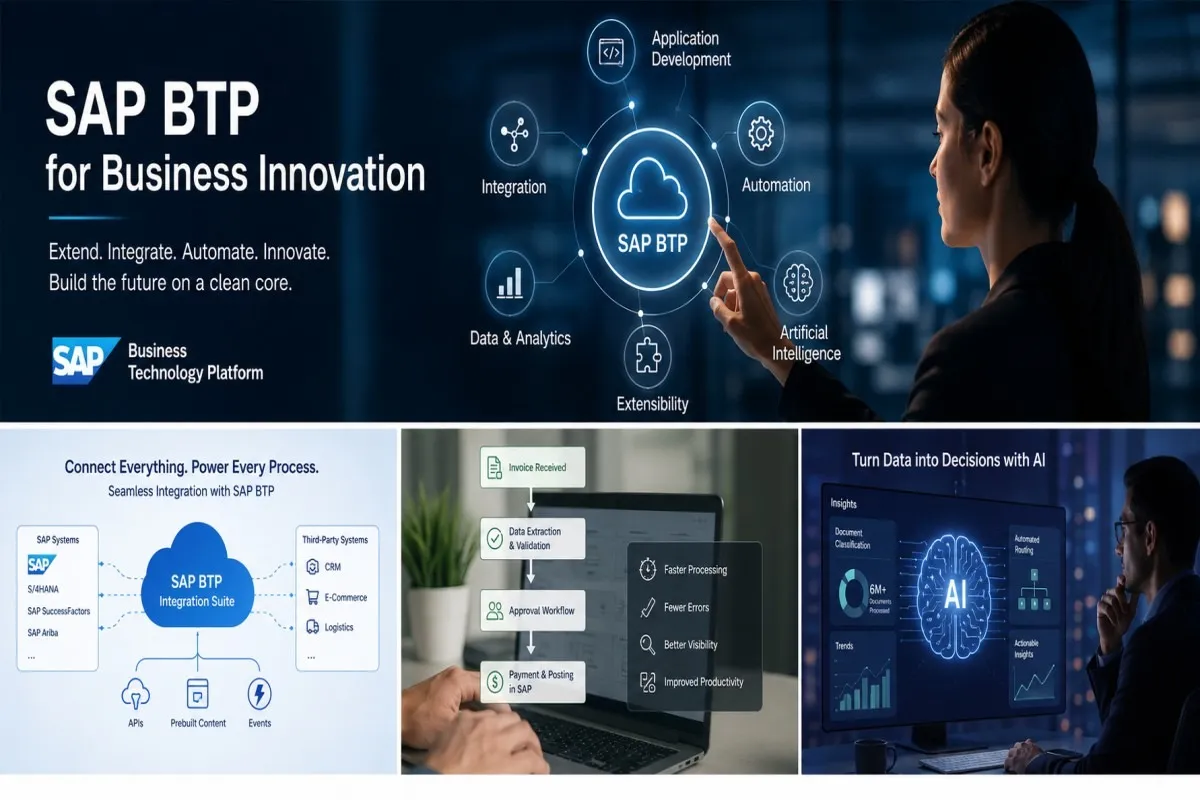
SAP BTP for innovation gives organisations a practical way to extend SAP applications, connect systems, automate processes and explore data-driven improvements without making unnecessary changes to the ERP core; all securely managed, governed, and optimized by an SAP BTP Administrator.
The strongest results come from starting with business needs, selecting suitable capabilities, running focused pilots and measuring outcomes. Customer examples from Harrods and the City of Hamburg illustrate what particular implementations have achieved, but they should not be treated as guaranteed results for other organisations.
For businesses looking to modernize their SAP landscape, the practical starting point is simple: identify one clear problem, validate the solution's value and scale only when the benefits are measurable.
To understand how SAP BTP concepts apply to practical business scenarios, explore SAP BTP scenario certifications for relevant preparation resources.
FAQs
1. Can SAP BTP replace SAP S/4HANA?
No. SAP BTP builds on SAP S/4HANA capabilities. S/4HANA still runs your core ERP processes. It adds extensions, integrations, automation and more.
2. What is clean core for SAP BTP projects?
It means keeping your ERP core as close to standard as possible. When you need more features, you can add them via sanctioned extension methods.
3. What advantages does SAP Integration Suite provide to businesses?
It connects SAP applications with third-party applications. So data can flow between systems and processes can be integrated.
4. Can SAP BTP be used to automate invoice processing?
Yes. You can route documents, verify details and send approval notices. How much you can automate depends on your process, quality of your data and on your business rules.
5. How should a business get started?
Begin with one clear business problem. Look at what you already have, then pick the capabilities that fit. Run a small pilot you can measure before you expand.
More Blogs


