
Beyond Automation: SAP Autonomous Finance
Beyond Automation: SAP Autonomous Finance.
Abstract:
The Autonomous Enterprise represents SAP’s vision for fundamentally changing how modern businesses operate. Instead of fragmented systems and manual handoffs, SAP S/4HANA enables finance and other domains to run as one connected, intelligent operation. AI assistants and agents execute end-to end-processes while people focus on strategic decisions. Here, I provide some examples of how SAP Autonomous Finance empowers businesses with cutting-edge AI and advanced architecture, including S/4HANA Pvt and Public Cloud.
Introduction
Today’s enterprises struggle with disconnected systems, manual reconciliations, and delayed decision-making. The Autonomous Enterprise, powered by SAP S/4HANA, changes this paradigm by integrating finance, supply chain, spend, HR, and customer operations into a single, adaptive model. Finance is at the core of this transformation: AI assistants and agents handle operational execution, from invoice to cash to treasury and compliance, while professionals remain in control of oversight and judgment. Joule, the engagement layer, brings context, workflows, and data directly to users, eliminating inefficiencies and enabling proactive responses. Supported by the SAP Business AI Platform, every action is governed, auditable, and secure.
Key Elements of the Autonomous Enterprise
- Joule as the new engagement layer, bringing together data, workflows, and agents across SAP systems and beyond.
- SAP Autonomous Suite to reinvent how enterprises run, based on AI assistants and agents executing work end-to-end.
- Industry AI embeds process knowledge, compliance rules, and data models specific to each industry.
- SAP Business AI Platform delivering business context, unified data, models, and enterprise-grade governance.
- Accelerate the evolution to an Autonomous Enterprise with agent-led transformation, delivered through RISE and GROW.
What is Autonomous Finance?
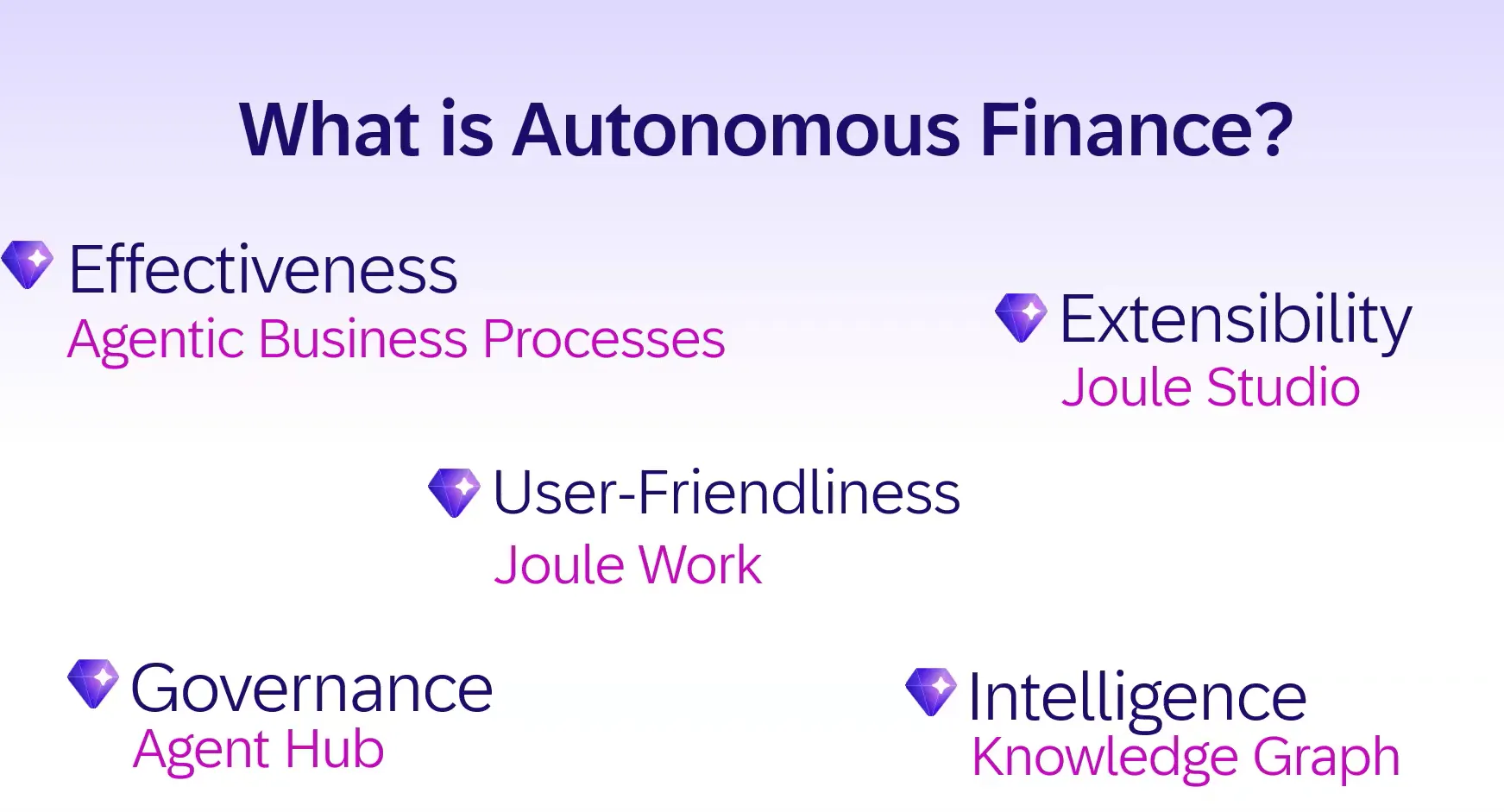
Autonomous Finance redefines enterprise operations by combining five core pillars. Effectiveness comes from agentic business processes that execute tasks autonomously. Extensibility is enabled through Joule Studio, allowing flexible design and adaptation. User-Friendliness is delivered via Joule Work, simplifying complex finance tasks. Governance is ensured through Agent Hub, providing oversight and compliance. Finally, Intelligence is powered by the Knowledge Graph, connecting enterprise data for contextual reasoning and smarter decisions. Together, these elements establish a new standard for intelligent, efficient, and autonomous financial management.
Credit: SAP
Autonomous Financial Closing with SAP Financial Closing Assistant
SAP’s Financial Closing Assistant turns the month-end close into a guided, semi-autonomous process. Routine runs are automated, agents handle complex reconciliations, and humans step in only for exceptions — making closing faster, more accurate, and audit-ready.
SAP’s Financial Closing Assistant orchestrates the Agentic Team Close by combining ERP automation, autonomous agents, and human-in-the-loop oversight across all phases of the close.
SAP Vision — Applications, Data, and AI Unified
SAP’s vision integrates applications, data, and AI into one intelligent enterprise framework. SAP envisions a connected enterprise where AI agents orchestrate processes, data is harmonized across systems, and applications run seamlessly — delivering efficiency, trust, and innovation.
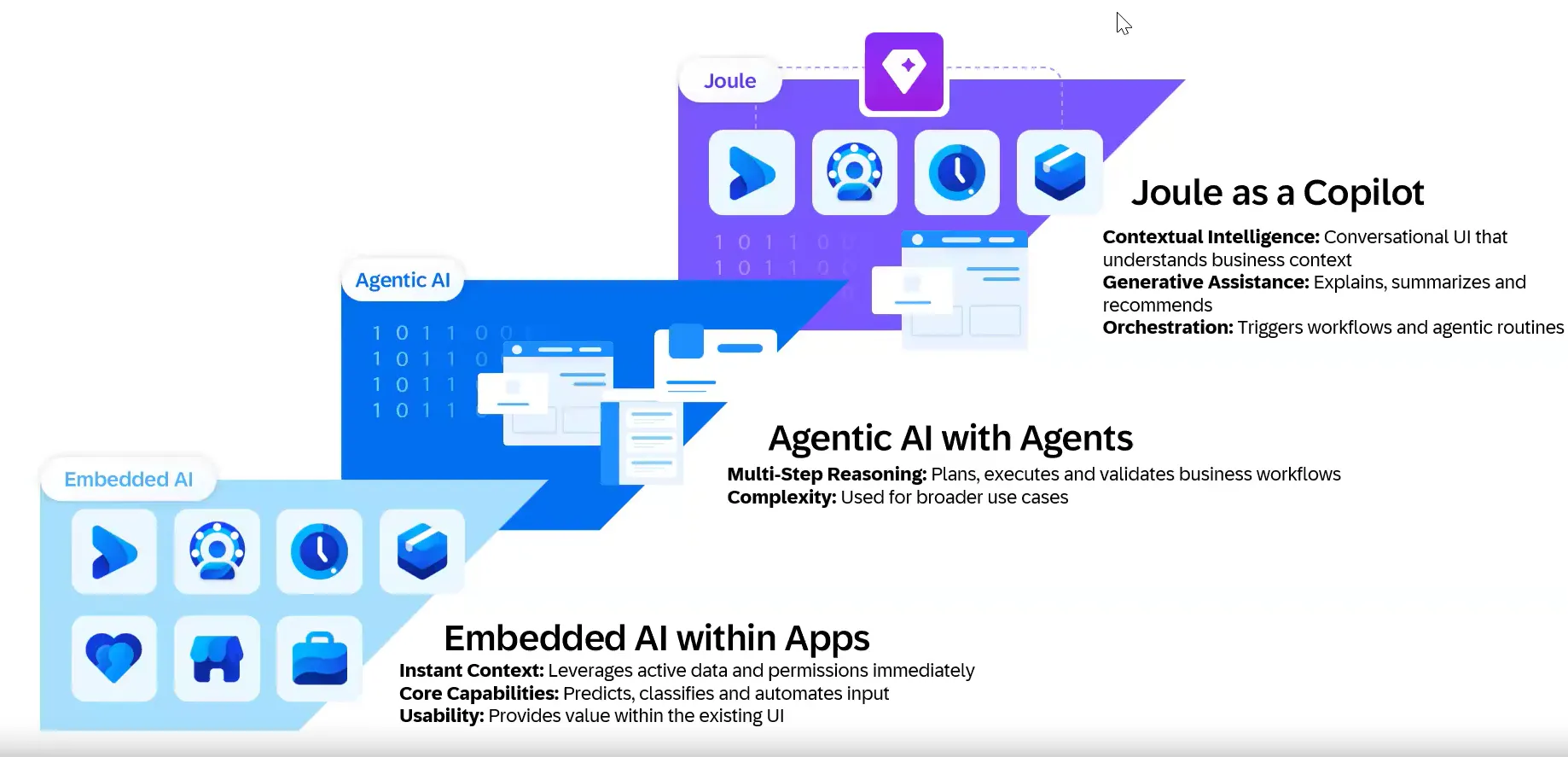
Three Perspectives of SAP AI
Credit: SAP
- Embedded AI Built directly into SAP applications; it uses active data and permissions instantly. It predicts, classifies, and automates inputs, delivering value within the existing user interface.
- Agentic AI Agents apply multi-step reasoning to plan, execute, and validate workflows. This enables broader, more complex use cases beyond single transactions.
- Joule Copilot Joule provides contextual intelligence through conversational UI. It explains, summarizes, and recommends, while orchestrating workflows and agentic routines across processes.
Joule
Joule transforms SAP experiences with multilingual support, AI-grounded trust, and agentic automation. It boosts productivity by 30% for key personas, simplifies consulting, and accelerates ABAP development. With transactional, navigational, and informational patterns, Joule orchestrates workflows across finance, HR, CX, spend, and supply chain — available seamlessly on mobile.
Credit: SAP
Joule Base vs. Premium
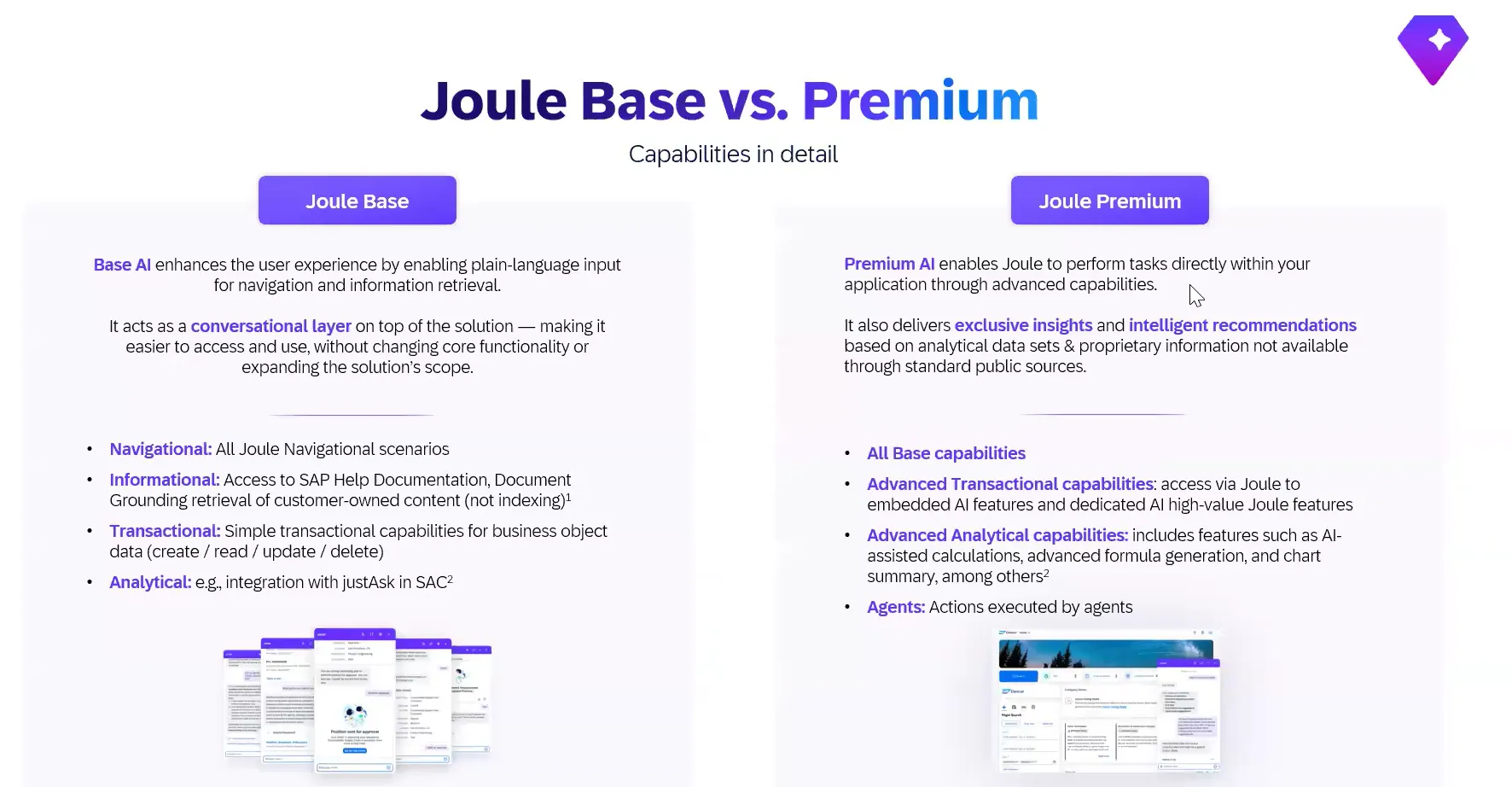
- Joule Base Provides conversational navigation and information retrieval. It supports plain language If includes in license.
- Joule Premium Builds on Base with advanced transactional and analytical features. It enables AI-assisted calculations, formula generation, chart summaries, and agent-driven actions. Premium needs separate license.
Industry AI
Industry AI gives the Autonomous Enterprise its real power by embedding industry-specific processes, regulations, and data models into every workflow. Unlike generic AI, it understands the unique realities of sectors such as energy, manufacturing, retail, and professional services.
Understanding How SAP Autonomous Finance Reshapes the Finance Function
Organizations today face mounting challenges. Fragmented data, manual processes, and insights that arrive too late to guide decisions. SAP Autonomous Finance is designed to address these pressures by shifting finance from periodic reporting to continuous intelligence. Instead of waiting for month-end or quarter0end cycles, AI agents reconcile transactions in real time, surface risk signals before they impact results, and coordinate responses across connected domains such as supply chain, procurement, HR, and customer operations.
Exploring How SAP Joule Assistants Orchestrate Finance Workflow
SAP Joule Assistants are at the heart of Autonomous Finance, reshaping how finance teams work by acting as intelligent teammates. Unlike generic AI that only provides answers, Joule Assistants understand the context of specific roles—whether billing, accounts receivable, treasury, or compliance—and coordinate the right agents to get the job done. They interpret intent in natural language, align it with the workflows and data of the role, and orchestrate multiple agents working behind the scenes.
For example, a Billing Assistant can detect inconsistencies early, validate data, and recommend corrective actions, reducing invoice disputes and posting errors. An Accounts Receivable Assistant predicts churn, prioritizes collections, and streamlines dispute resolution, accelerating cash recovery. Similarly, a Financial Closing Assistant orchestrates postings, reconciliations, and validations, shortening close cycles while improving reporting accuracy. Each assistant leverages SAP’s Knowledge Graph and Business Data Cloud to ground actions in real time, trustworthy data.
Identifying SAP Joule Agents for Core Finance Workflows
SAP Autonomous Finance brings together assistants, agents, and data to transform core finance domains such as planning, treasury, accounting, revenue management, compliance, and tax. Joule Assistants act as role aligned teammates, coordinating agents that execute tasks behind the scenes.
Example 1: Streamlining Dispute Management with the Dispute Resolution Agent
The Dispute Resolution Agent transforms one of finance’s most complex challenges—customer payment disputes—into a faster, smarter process. Traditionally, collections teams spend days cross checking invoices, contracts, and delivery records to uncover errors. This agent automates that work, scanning documents to detect discrepancies and recommending corrective actions such as credit memos or invoice adjustments. By reasoning over context and applying business rules, it ensures solutions are accurate and compliant. Most importantly, disputes are resolved in hours instead of weeks, strengthening customer trust and improving cash recovery. It turns a pain point into a strategic advantage for finance teams.
Example 2: Financial Closing Assistant
Financial Closing Assistant enables agent-assisted closing, reducing cycle time, improving accuracy, and delivers AI-powered period-end excellence
Why Business AI Is Evolving — And What That Means in Practice
Business AI is shifting from user-centric models to execution-driven paradigms, where value is measured by actions completed end-to-end rather than user counts. Agentic AI delivers impact through automation, outcomes, and scalable consumption, replacing traditional pricing with transparent, consumption anchored models. Premium capabilities now focus on agents priced per action, while generative AI becomes baseline, democratizing access and embedding intelligence into daily processes.
SAP S/4HANA Cloud Private Edition – AI-Enabled Journal Upload
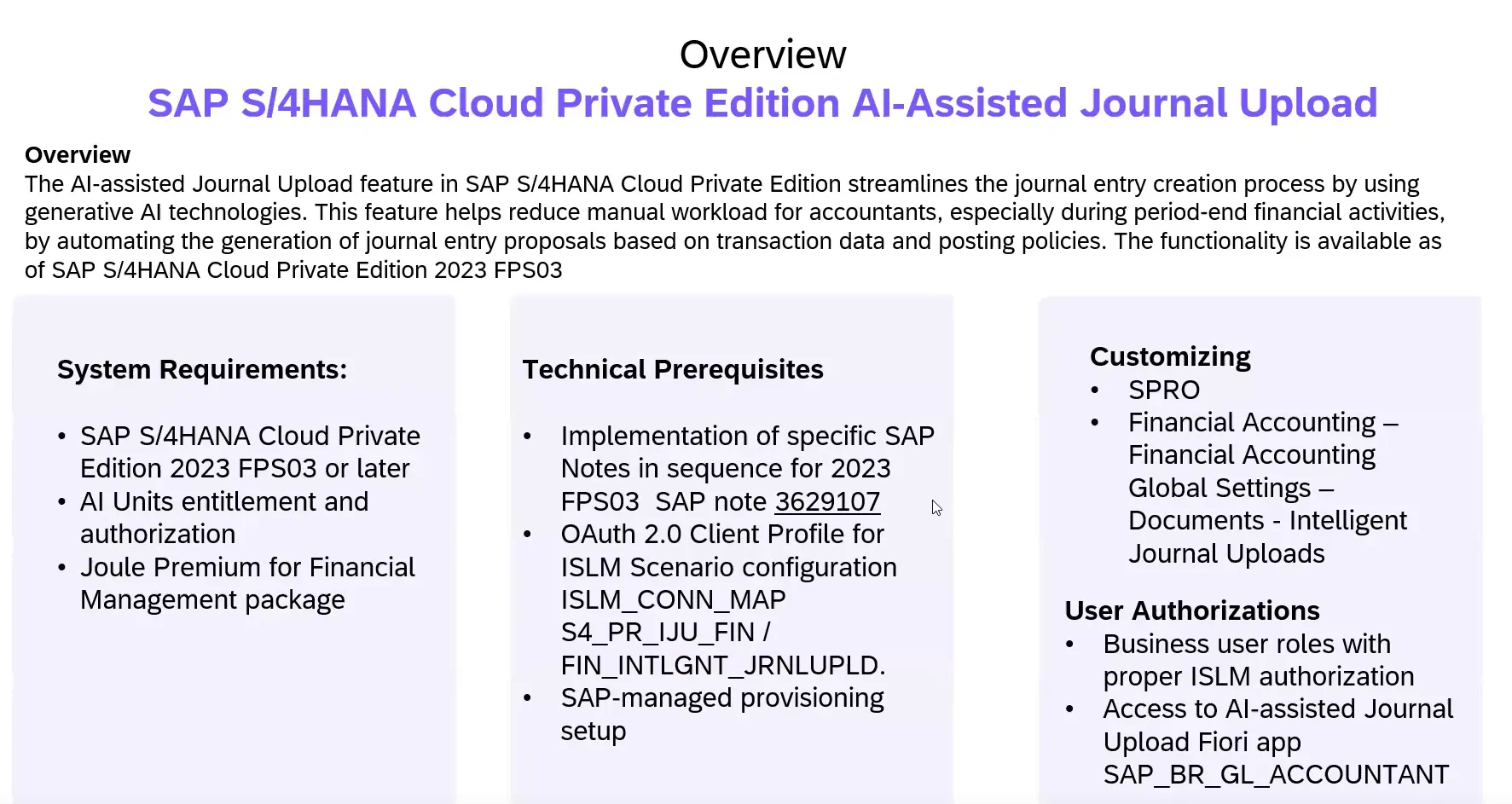
The AI-assisted journal upload in SAP S/4HANA Cloud Private Edition streamlines financial postings by reducing manual effort, especially during period-end close. Available from release 2023 FPS03 onward, it leverages generative AI to simplify journal entry creation and improve efficiency for accountants.
System Setup
- Requires SAP S/4HANA Cloud Private Edition 2023 FPS03 or later
- Needs entitlement to AI Units and authorization
- Joule Premium for Financial Management package
Technical Setup
- Apply SAP Notes in sequence (e.g., 3629107 for FPS03)
- Configure OAuth 2.0 Client Profile for ISLM scenarios (ISLM_CONN_MAP S4_PR_IJU_FIN / FIN_INTLGNT_JRNLUPLD)
- Ensure SAP managed provisioning
Configuration
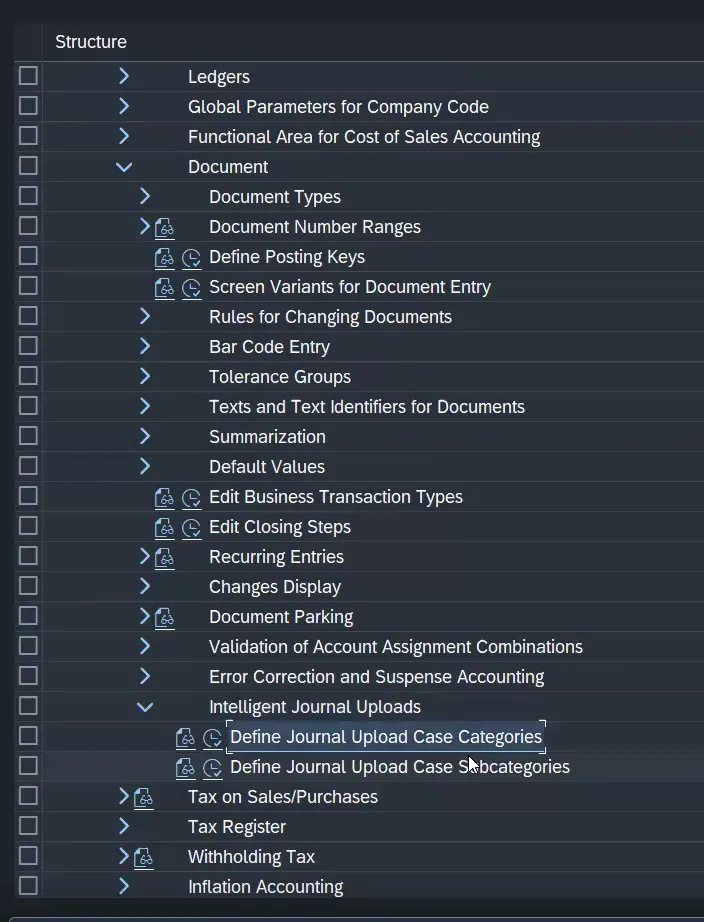
- Navigate via SPRO → Financial Accounting → Global Settings → Documents → Intelligent Journal Uploads
User Access
- Assign appropriate ISLM authorizations
- Provide access to the Fiori app “AI-Assisted Journal Upload” with role SAP_BR_GL_ACCOUNTANT
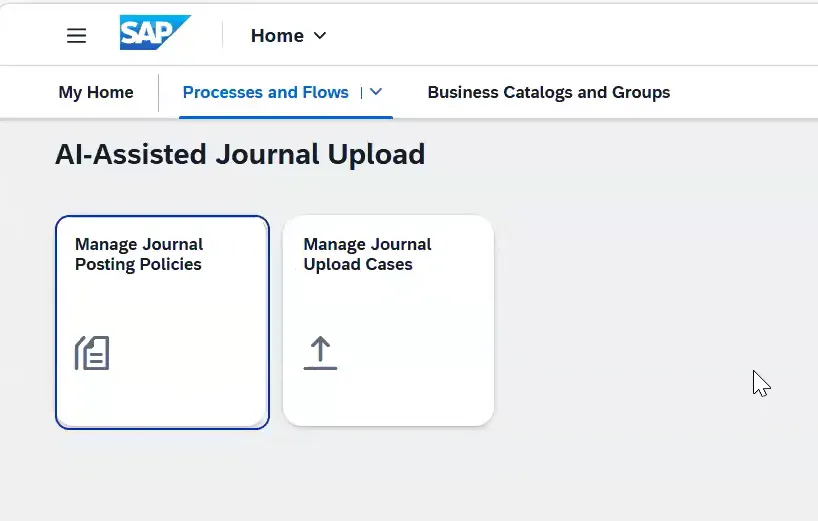
First, we upload Policy document in first app
Policy Document Supporting files (e.g., Excel templates) are attached to guide AI in applying consistent posting rules. Posting policies act as the rulebook for AI-assisted journal uploads. They define categories, attach documentation, and provide governance so that AI can generate consistent, auditable journal entries with minimal manual effort.
Once the Policy is created, we need to activate
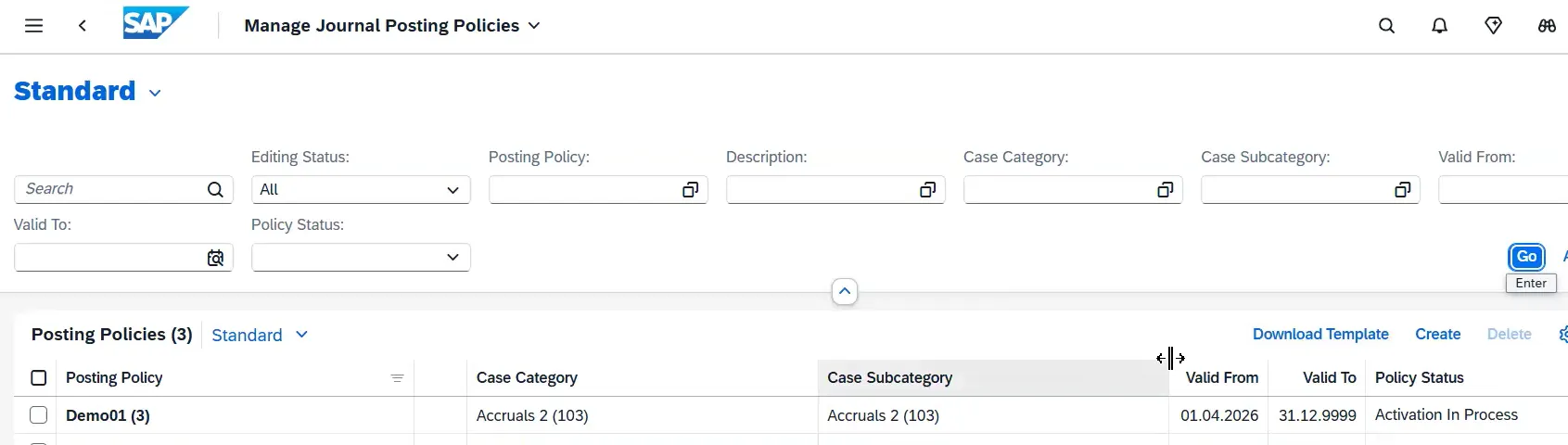
Once the Policy document is activated, then we will move to the next step – upload cases. Here you can validate and post. We can also create workflow here.
Efficiency Gains
- Without AI: ~120 minutes for manual analysis and posting.
- With AI: ~15 minutes to upload and review proposals.
- Benefit: Up to 70% time saved per accrual/provision case, with improved consistency and reduced manual workload.
Next Use Case:
AI Explanation of Depreciation Keys in SAP Cloud ERP
Contextual Guidance
When the user selects a depreciation key (e.g., LINS), AI generates a clear explanation of its logic, phases, and calculation methods
Efficiency Gains
Instead of manually interpreting technical rules, accountants receive AI-generated descriptions that reduce onboarding effort by up to 75%.
AI translates complex depreciation keys into plain, structured explanations. This helps users configure faster, understand rules clearly, and ensure consistency without spending hours configuring settings.
https://www.sap.com/assetdetail/2024/10/b6e05e7e-da7e-0010-bca6-c68f7e60039b.html
Another Use Case
SAP S/4HANA Cloud Private Edition, fixed-asset key figures explanation – (AI-Assisted Explanation of Asset Key Figures)
https://discovery-center.cloud.sap/ai-feature/780e16a7-74cf-4118-b200-c13484d2f9b5/
Purpose
AI translates complex fixed asset calculations into natural language, helping finance teams quickly understand depreciation, APC (Acquisition and Production Cost), and net book values.
Process
- The system identifies the depreciation method (e.g., straight-line).
- It explains the base value (acquisition cost), percentage rate, and period factor.
- AI applies the formula (Depreciation Amount = Base Value × Rate × Factor) and shows how values flow into net book value
Efficiency Gains
Without AI: ~75 minutes to analyse asset valuation queries.
With AI: ~18 minutes — 75% reduction in effort.
Business Value
AI takes the technical tables of asset values and explains them step-by-step, showing how depreciation and APC flow into net book value. This saves time, improves clarity, and ensures accountants can make faster, more confident decisions.
Another Use Case:
AI-Assisted Error Remediation in Financial Closing (I am not sure if this is available in discovery centre)
Prescriptive Guidance AI provides step-by-step instructions to resolve errors, ensuring closing tasks stay on track.
Error Reduction
Without AI: ~7% of unknown errors require manual investigation.
With AI: ~0.7% require manual intervention — a 90% reduction in effort.
Efficiency Gains
AI minimizes manual workload, accelerates closing cycles, and improves consistency across automated tasks.
Business Value
AI transforms financial closing from a reactive, error-prone process into a guided, proactive workflow — accountants spend less time investigating and more time validating results.
Another Use Case:
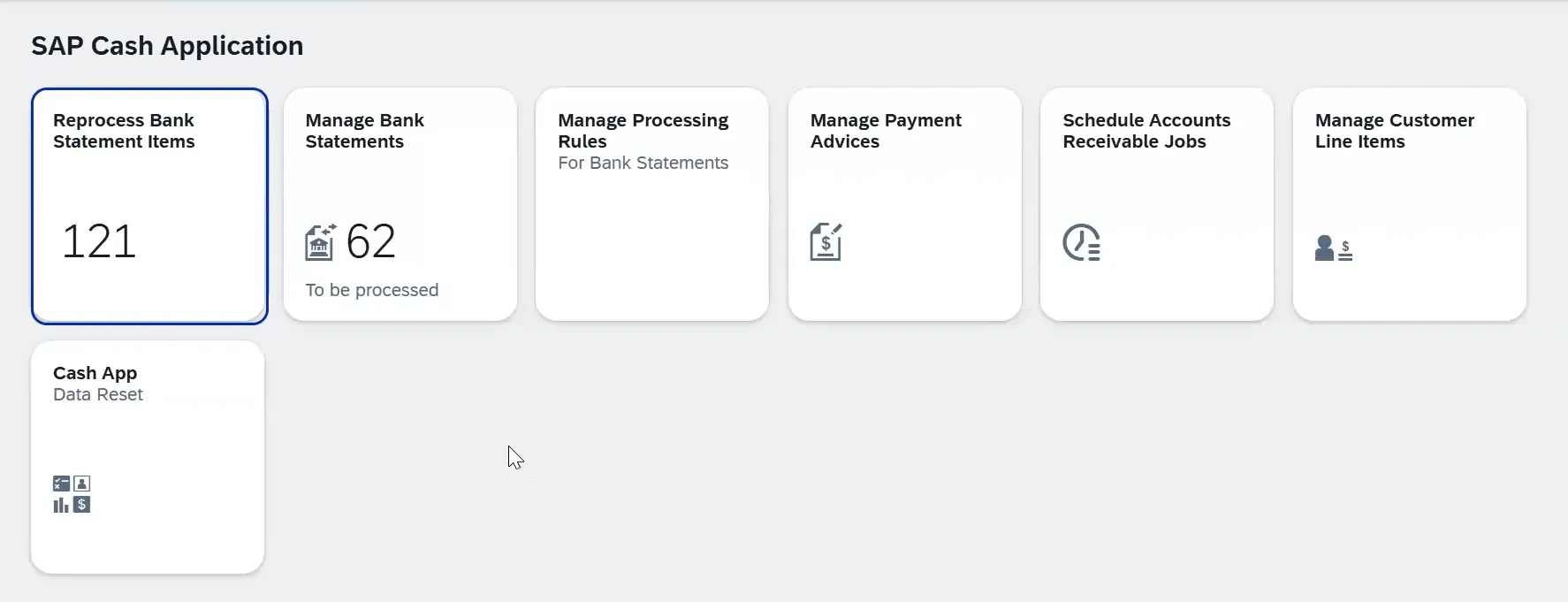
AI-Assisted Cash Application in SAP FI AR
Purpose
Automates the matching of incoming bank statement items with open accounts receivable/payable items using machine learning.
Business Value
- Faster clearing processes.
- Reduced manual workload for finance teams.
AI makes payment matching almost fully automatic. Instead of accountants manually reconciling bank statements with invoices, the system learns patterns and clears items on its own — saving time, reducing errors, and improving cash flow visibility.
https://discovery-center.cloud.sap/ai-feature/8adc6e0a-2994-455e-8c0d-ecb27f311afa/
Another Use Case:
AI-Driven GR/IR Reconciliation
Purpose
Automates reconciliation of purchase order items where there are mismatches between goods receipts and invoice receipts.
Process
- AI analyses purchasing documents across company codes.
- Detects exceptions such as surplus goods receipts, missing invoice postings, or amount differences.
Efficiency Gains
- Increased speed in reconciliation of GR/IR accounts.
- Faster month-end closing cycles.
- Reduced manual investigation effort by guiding accountants directly to mismatched items.
Business Value
- Improved accuracy in financial reporting.
- Reduced operational risk from unreconciled accounts.
- Clear visibility into supplier and purchasing document discrepancies
AI looks at mismatches between goods received and invoices posted, explains why they occurred, and suggests the next steps. This speeds up reconciliation and makes month-end closing smoother.
Another Use Case:
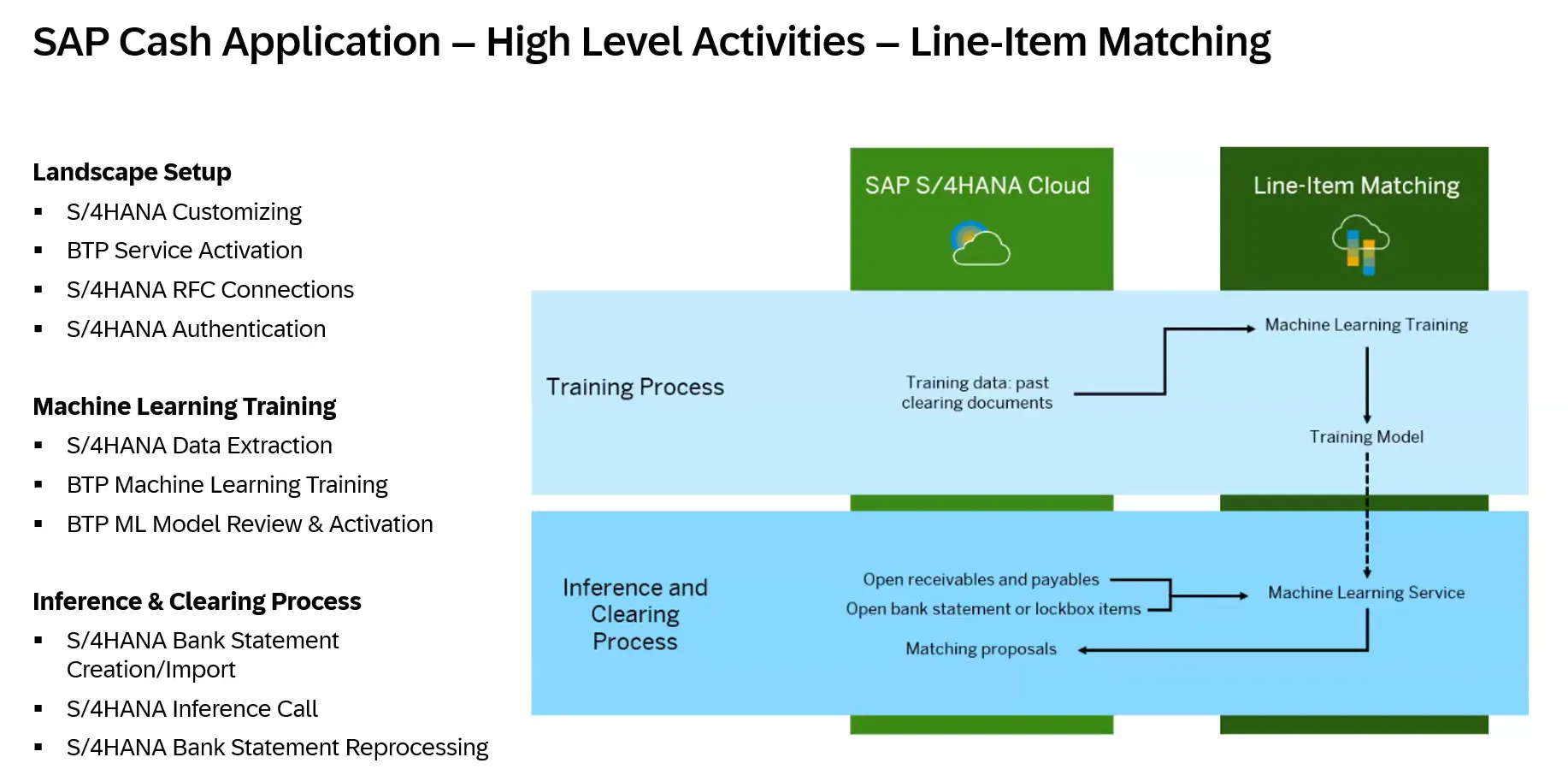
SAP Cash Application – Machine Learning Driven Line Item Matching
SAP’s Cash Application automates receivables management by integrating machine learning into the line item matching process. The workflow begins with system setup—configuring S/4HANA, activating BTP services, and establishing secure RFC connections with proper authentication. Once the environment is ready, historical clearing data is extracted from S/4HANA and used to train models in BTP. These models are reviewed, validated, and activated for production use. During daily operations, bank statements are imported into S/4HANA, inference calls are made to the ML service, and intelligent matching proposals are generated for open receivables and payables. This automation accelerates clearing, minimizes manual effort, and enhances financial accuracy.
Credit: SAP
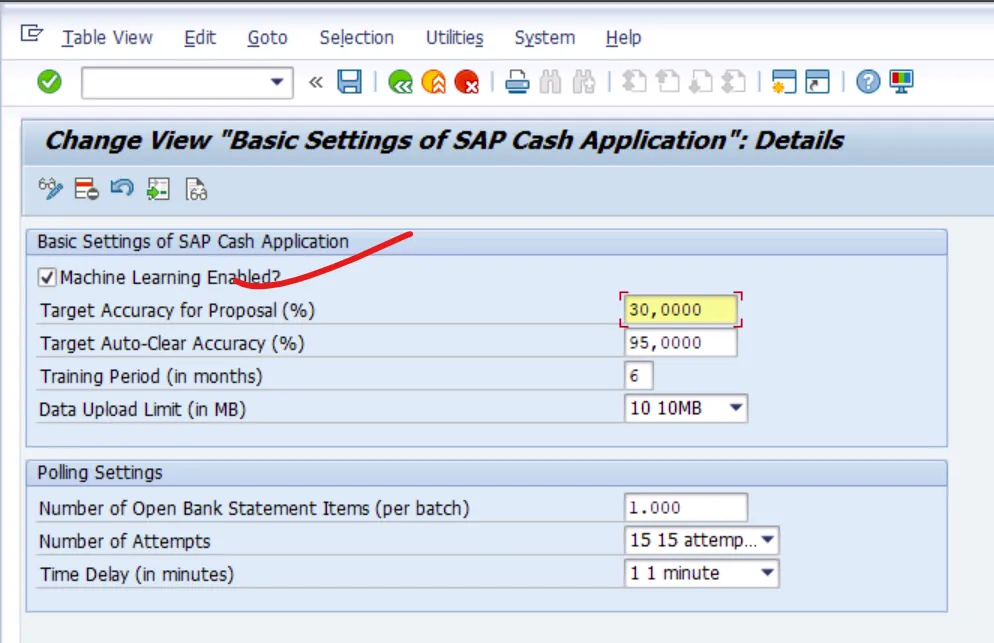
Integration with Other SAP Components >>Machine Learning Integration>>SAP Cash Application>>Basic Settings>>
Here, Maintain basic settings for machine learning in SAP Cash Application.
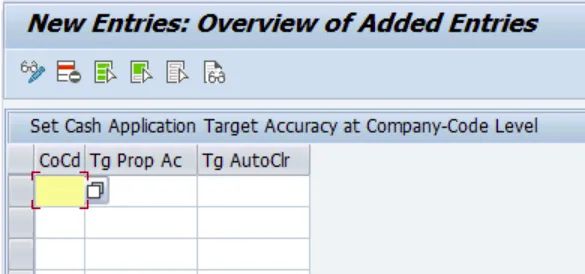
Then, the next configuration step is: Integration with Other SAP Components >>Machine Learning Integration>>SAP Cash Application>> Set Target Accuracy at Company-Code Level
Here, you can configure proposal and auto-clearing target accuracy for Cash Application at the company-code level. When there is no entry found for a specific company-code, default accuracy from Basic Settings will be used.
Target accuracy for proposal and auto-clearing has been configured on Basic Settings, however there are company codes which need different proposal and auto-clearing accuracy during processing.
This setup is optional.
When there is a need to specify different target accuracy for proposal and auto-clearing for certain company-code, configuration can be entered here.
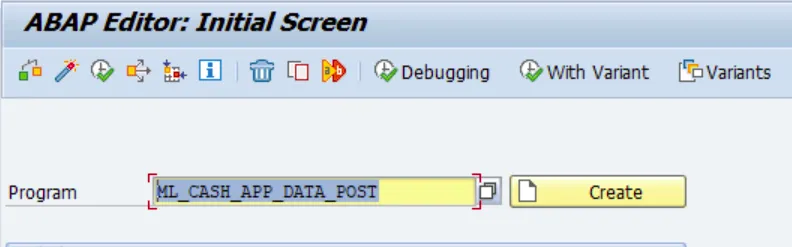
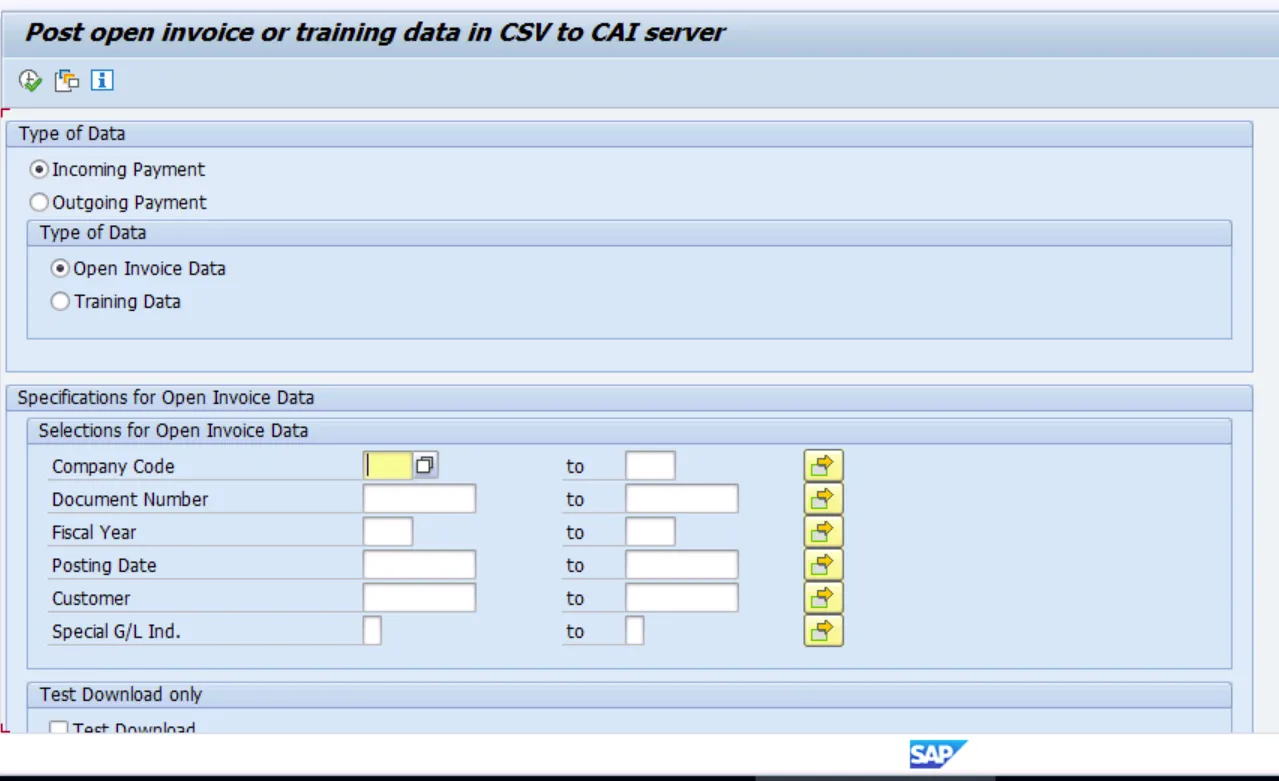
In SAP, the program ML_CASH_APP_DATA_POST is part of the SAP Cash Application solution that is used for data extraction (machine learning to automate the posting of incoming payments against open receivables)
SAP Document AI
SAP Document AI is an end-to-end document processing solution for structured and unstructured data from a wide range of business documents that helps streamline data handling and automate business processes.
Processing Payment Advice with SAP Document AI
SAP Document AI brings automation and intelligence to payment advice handling, reducing manual effort and improving accuracy. By leveraging the PAYMENT_ADVICE_STANDARD schema, the system extracts key details such as amounts, references, and currencies directly from uploaded files.
More Blogs


