
Eursap's Ask-the-SAP-Expert – Rajesh Arangamany
Ask-the-SAP-Expert – Rajesh Arangamany.
This month, we feature Rajesh Arangamany. Rajesh is based in the Greater St. Louis area in the USA and is a Principal Enterprise Architect at SAP, bringing over 21 years of deep expertise in ERP enablement, large-scale transformations, S/4HANA programs, and the strategic integration of AI into SAP landscapes. As a Certified AI Transformation Leader and active thought leader, authoring insightful articles on Joule (SAP's AI copilot), Clean Core strategies, SAP Business AI, and governance for sustainable value, Rajesh advises global organizations on aligning complex modernization initiatives with measurable business outcomes. He’s also SAP’s Campus Ambassador for Carnegie Mellon University and a frequent speaker on emerging SAP architecture trends. Let’s have a chat with Rajesh and hear his real-world perspectives on navigating ERP and AI transformations!
Hi Rajesh and thank you for agreeing to chat to us. For readers who do not know you, can you give us a 30 second elevator pitch?
Over the past 21 years, I’ve worked at the intersection of enterprise architecture, ERP transformation, and business strategy. My focus has been helping global organisations navigate complex modernisation initiatives, especially large SAP S/4HANA transformations while ensuring technology decisions remain closely aligned with measurable business outcomes.
A big part of my work centers on governance-centric architecture: creating frameworks that connect executive strategy to solution design, operational execution, and value realisation. By establishing structural traceability across the transformation lifecycle, organisations can manage risk more effectively and ensure that multi-year ERP programs deliver sustainable business value rather than just technical upgrades.
Based on your 20+ years advising global organisations, what are the most common patterns you've observed in successful S/4HANA transformations, and how do they differ from those that lead to failures?
Across many programs I’ve observed a few consistent patterns.
Successful transformations treat S/4HANA not as an IT upgrade but as a business transformation program. Leadership establishes clear governance structures, aligns architecture decisions with enterprise capabilities, and defines measurable outcomes from the start.
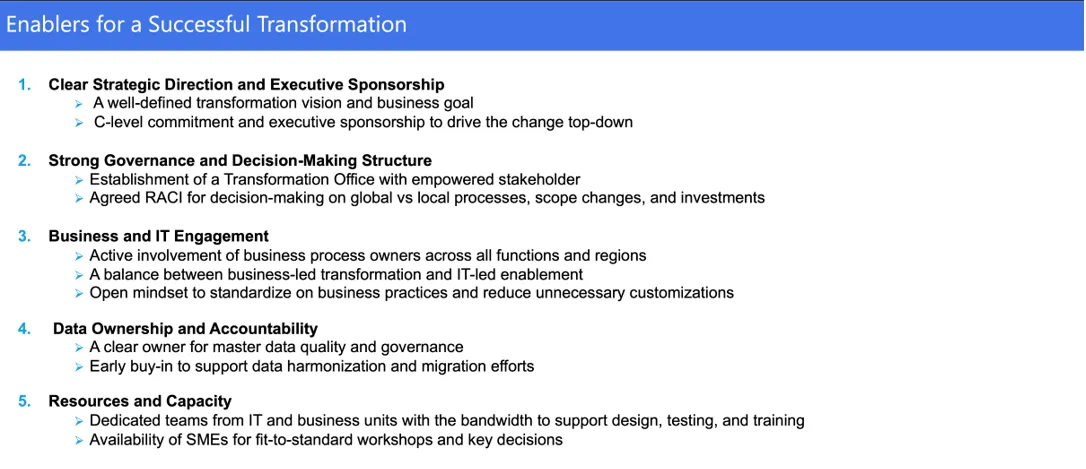
Less successful initiatives often focus heavily on the technical migration while underinvesting in governance and business alignment. Without strong architectural guardrails, scope expands, customisations accumulate, and the transformation loses strategic focus.
The most effective organisations create a governance framework that links strategic objectives, architectural standards, and implementation decisions so that every technical change can be traced back to business value.
In your experience leading large-scale ERP programs, what governance models have proven most effective for ensuring alignment between IT and business stakeholders?
The most effective governance models operate at multiple levels.
At the strategic level, executive steering structures ensure that transformation objectives remain aligned with business priorities. At the architectural level, enterprise architecture provides the structural discipline that connects business capabilities, process design, and technology decisions.
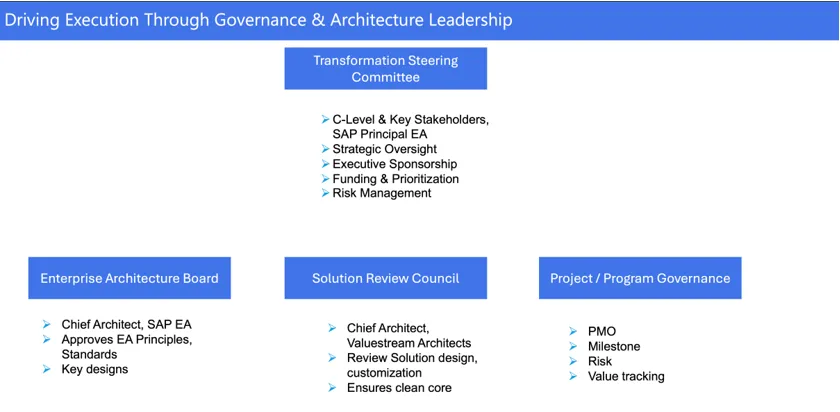
I’ve found that governance works best when it emphasises decision transparency and traceability. When architecture decisions, integration patterns, and capability changes are clearly documented and reviewed through structured governance forums, IT and business stakeholders can collaborate more effectively and avoid costly rework.
How has the role of the CIO evolved in the era of AI-driven transformations, and what key skills do you recommend they develop to act as effective orchestrators?
The role of the CIO has evolved from technology operator to strategic transformation orchestrator.
With AI becoming embedded across enterprise platforms, CIOs must now balance innovation with governance, risk management, and organisational alignment. They are responsible not only for technology architecture but also for ensuring that AI initiatives deliver ethical, secure, and measurable outcomes.
The most effective CIOs today develop strong capabilities in enterprise architecture, data governance, and cross-functional leadership. They must be able to translate emerging technologies into business value while maintaining architectural discipline across the enterprise.
As a Certified AI Transformation Leader, how do you advise organisations to integrate AI responsibly into their SAP landscapes, avoiding common pitfalls like ethical concerns or over-reliance on automation?
Responsible AI adoption requires both technical capability and governance maturity.
Organisations should begin by identifying business scenarios where AI can augment decision-making rather than simply automate tasks. From there, governance structures should address data quality, model transparency, and ethical considerations.
In SAP environments, platforms like SAP Business Technology Platform, Business Data Cloud, Joule Unified Business AI allow organisations to integrate AI capabilities while maintaining architectural control. When combined with clear governance processes, this enables companies to innovate responsibly without introducing unnecessary operational risk.
Drawing from your recent article on Joule, SAP's AI copilot, how can teams leverage tools like this to simplify complex SAP processes and drive real business value?
Tools like SAP Joule represent an important shift in how users interact with enterprise systems.
Instead of navigating complex workflows, business users can access insights through conversational interfaces that simplify decision-making. For example, supply chain managers might use Joule to quickly analyse inventory trends or identify process bottlenecks.
The key is to integrate these capabilities thoughtfully within enterprise processes so they enhance productivity while maintaining governance and data integrity.
What strategies do you recommend for accelerating a "Clean Core" approach in S/4HANA implementations, and how does SAP Cloud ALM support this journey through its quality gates?
Accelerating a Clean Core approach in SAP S/4HANA requires a governance-led strategy that prioritises fit-to-standard processes and minimises unnecessary customisations through clear decision frameworks. A tiered extensibility model leveraging side-by-side innovations, APIs, and compliant on-stack extensions helps keep the core stable while enabling flexibility. Success depends on defining measurable KPIs for technical debt and sustaining governance throughout the lifecycle. SAP Cloud ALM supports this journey by enforcing structured quality gates, ensuring compliance across key dimensions, and providing real-time dashboards like Clean Core Methodology dashboard for continuous monitoring and long-term clean core adherence.
In your view, what are the biggest challenges in modernising legacy ERP systems to incorporate enterprise AI, and how have you helped organisations overcome them?
Modernising legacy ERP systems to incorporate enterprise AI presents challenges around fragmented data landscapes, heavy customisations, and lack of scalable architecture. Many organisations struggle with poor data quality, siloed processes, and legacy code that limits AI readiness. In my experience working with platforms like SAP S/4HANA and other SAP LOB solutions, the key is to first establish a clean digital core like SAP BTP by reducing custom code and standardising processes, followed by building a robust data foundation with governed, high-quality datasets. I have helped organisations adopt a side-by-side innovation approach using SAP Business Technology Platform to enable AI use cases without disrupting the core. Additionally, implementing strong governance and lifecycle controls through SAP Cloud ALM, ensures that AI initiatives remain scalable, compliant, and aligned with business outcomes.
From your speaking engagements, such as the Next Generation SAP Enterprise Architect Learning Forum, what emerging trends in SAP architecture are you most excited about for 2026 and beyond?
I’m most excited about how SAP is evolving into an AI first, truly intelligent, cloud-first platform. Trends like AI integration into core processes, SAP Integrated Toolchain (LeanIX, Signavio, SAP Cloud ALM) Clean Core adoption with SAP Cloud ALM, and event-driven, modular architectures are enabling organisations to innovate faster while simplifying operations. I also see growing opportunities for data-driven sustainability, which aligns business efficiency with environmental impact.
How can SAP professionals upskill in areas like AI and cloud to stay competitive, especially with certifications like SAP Business Technology Platform and Enterprise Architecture Consultant? In fact, how do you keep yourself up to date?
SAP professionals can effectively upskill by embracing structured learning paths and certifications. For example, SAP Business Technology Platform (BTP) offers modules focused on integration, analytics, and AI/ML services, while the SAP Enterprise Architecture Consultant certification covers solution architecture, process design, and cloud strategy, which are essential for next-generation SAP landscapes. Earning these certifications signals both formal mastery and a commitment to staying current in a rapidly evolving ecosystem.
Hands-on practice is equally important. Building proof-of-concept projects using SAP BTP AI/ML services or cloud integrations allows professionals to apply theoretical knowledge in real-world scenarios. Experimenting with tools like SAP Cloud ALM, SAP Integration Suite, or SAP AI Core further deepens practical expertise and prepares professionals for complex enterprise implementations.
Engaging with communities and thought leadership platforms also accelerates learning. Participating in forums such as SAP Community, Eursap or ASUG events provides exposure to emerging trends, while following SAP blogs, white papers, and SAP TechEd sessions ensures access to actionable guidance and best practices.
Continuous learning through microlearning approaches is critical to keep pace with rapid technological updates. Platforms like SAP Learning Hub and OpenSAP courses offer modular learning, and combining these with AI and cloud certifications from AWS, Azure, or Google Cloud provides a broader understanding of how cloud technologies integrate with SAP BTP.
Finally, mentorship and knowledge sharing reinforce expertise. By mentoring junior colleagues, leading internal workshops, or writing blogs, professionals not only solidify their own understanding but also demonstrate influence and thought leadership within the SAP community.
I stay current by combining structured learning with hands-on practice. I regularly complete SAP Learning Hub and OpenSAP courses, experiment with AI/ML and integration capabilities in SAP BTP, and attend forums like Eursap and SAP TechEd to exchange insights with peers. I also mentor teams and publish articles, which not only reinforce my knowledge but helps shape the community’s understanding of emerging SAP architecture trends.
Based on your expertise in SAP MM and WMS modules, how does AI integration enhance supply chain and materials management in global operations?
AI integration in SAP MM (Procure to Pay) and WMS (Warehouse Management System/EWM) is transforming global supply chain operations by shifting processes from reactive to predictive and autonomous. Key benefits include AI-driven demand forecasting, intelligent procurement, optimised inventory levels, and automated warehouse operations, which collectively improve resilience, reduce costs, and accelerate order fulfillment across global networks.
In procurement processes, AI enhances efficiency and decision-making. Intelligent procurement and sourcing in SAP Ariba and S/4HANA automate supplier matching, detect maverick spending, and use natural language processing (NLP) to analyse contracts. Predictive demand planning leverages machine learning to evaluate historical internal data alongside external signals such as weather and economic trends, enabling more accurate forecasts and reducing safety stock levels. Additionally, AI-driven supplier risk management monitors supplier health and geopolitical risks, predicting disruptions and recommending alternative sourcing strategies.
For warehouse operations in SAP EWM, AI enables smarter logistics processing by automating document handling, including delivery notes and bills of lading, reducing manual data entry. Machine learning optimises slotting, putaway, and picking strategies, significantly improving speed and accuracy. AI also integrates with robotics and autonomous vehicles to streamline warehouse operations while reducing costs. Predictive maintenance ensures high uptime for equipment by forecasting potential failures before they occur.
The impact on global operations is substantial. AI provides end-to-end visibility across logistics networks, helping teams anticipate disruptions and respond proactively. Operational efficiency is enhanced through automated invoice verification, AI-driven inventory optimisation, and smarter routing, which reduces bottlenecks. Cost savings are realised by optimising inventory levels, reducing manual errors, and improving overall service levels, enabling organisations to maintain highly resilient and efficient global supply chains.
What measurable business outcomes have you seen from AI-enabled SAP transformations, such as in finance, logistics, or predictive analytics?
In my experience leading AI-enabled SAP transformations, the measurable business outcomes are significant across finance, logistics, and predictive analytics. In finance, AI-driven automation of accounts payable and predictive cash-flow analysis has reduced manual processing time by up to 40% and improved forecast accuracy by 20–25%. In logistics, predictive inventory optimisation and intelligent routing have cut stock-outs by 30%, reduced warehouse picking errors by 35%, and shortened order-to-delivery cycles by several days. Across predictive analytics, AI models embedded in S/4HANA enable early identification of supply chain disruptions and demand shifts, allowing proactive interventions that save millions in potential downtime or excess inventory. These results demonstrate not only operational efficiency but also the strategic value of integrating AI into SAP landscapes, showcasing how intelligent enterprise initiatives deliver measurable, bottom-line impact.
In large ERP programs, how do you balance innovation (like AI agents) with maintaining system stability and upgradability?
In large ERP programs, balancing innovation with system stability and upgradability requires a deliberate, multi-layered approach. I advocate for a Clean Core strategy in S/4HANA, where AI agents and other innovations are implemented in extensions or side-by-side applications rather than directly customising the core system. This ensures that the core remains stable and upgrade-ready while still enabling advanced capabilities.
We also rely on SAP Cloud ALM and quality gates to manage deployments, monitor system performance, and validate AI-driven processes before they go live. Rigorous testing frameworks, sandbox environments, and staged rollouts allow teams to evaluate innovation impacts without risking disruption.
Finally, governance and cross-functional collaboration are critical. By aligning business stakeholders, architects, and IT teams, we prioritise innovations that deliver measurable value while preserving long-term system resilience. This approach not only supports continuous improvement but also ensures that ERP programs remain agile, scalable, and ready for future upgrades.
Looking ahead, how do you see AI reshaping cross-industry SAP strategies, and what one actionable step would you suggest for leaders starting their AI journey today?
AI will fundamentally reshape cross-industry SAP strategies by enabling organisations to move from reactive operations to predictive, autonomous processes across finance, supply chain, and customer engagement. Industries will increasingly leverage AI-driven insights to optimise inventory, forecast demand, automate procurement, and personalise customer experiences, making ERP systems not just transactional platforms but strategic decision engines. For leaders starting their AI journey today, my actionable recommendation is to begin with high-impact pilot projects that integrate AI capabilities in areas like predictive demand planning (Integrated Business Planning) or intelligent procurement (Ariba). This approach allows organisations to demonstrate measurable value quickly, build internal expertise, and scale AI adoption confidently while maintaining system stability and alignment with overall SAP strategy.
When I look through your profile, Rajesh, I am amazed that you have time to do it all! How do you find time for personal stuff like hobbies and interests?
I view personal time not as an escape from my work, but as a strategic necessity that sustains it. Leading high-stakes SAP programs requires immense focus and creativity, and I’ve found that I am most effective when I am well-rounded. By carefully structuring my schedule, I protect time for family and hobbies, which allows me to disconnect and gain fresh perspectives. This balance actually sharpens my decision-making and keeps me energised, ensuring that when I am at work, I can give my full, undistracted attention to the innovation and strategic priorities our clients depend on.
As SAP's Campus Ambassador for Carnegie Mellon, what advice do you have for students or early-career professionals entering the SAP and AI field?
As SAP’s Campus Ambassador for Carnegie Mellon, I encourage students and early-career professionals to approach the SAP and AI field with a mindset of continuous learning and hands-on experimentation. My advice is to combine formal training—through SAP Learning Hub, OpenSAP courses, and relevant certifications like BTP or Enterprise Architecture—with real-world projects, hackathons, or internships that let you apply concepts in practical scenarios. Building a strong foundation in data analytics, AI/ML, and cloud integration alongside core SAP modules creates a unique skill set that is highly valued across industries. Equally important is engaging with SAP communities, forums, and mentorship programs, which accelerates learning, expands your network, and provides exposure to emerging trends. Above all, focus on solving real business problems, as practical impact is what differentiates high-potential talent in the SAP ecosystem.
More Blogs


